More than just a pet

In the months prior to my diagnosis, the Boyfriend and I had been discussing when it would be a good time to get a dog.  One of the many reasons we had bought the house earlier that year was its double lot – perfect for a dog.  For about five months after moving into the house, we devoted most of our time and energy into clearing up the backyard, which the previous owners apparently forgot was a part of their home.  Weeds, years of un-raked leaves, literally garbage behind the detached garage, and so many “garbage” trees and a fence falling apart.

Once we got that all cleaned up, the next step was a dog.  However, that fall, I was diagnosed with breast cancer.

Two months into my treatment – including the initial shock, lumpectomy and beginning chemotherapy, I had come to the conclusion: it’s not a good time to get a dog.  I couldn’t see managing a dog, working full time and undergoing treatment for cancer.  Even though I was working from home, I still thought it would be a terrible idea to get a dog.

When the Boyfriend called me from the local animal shelter in mid December because he couldn’t think of a Christmas gift for me and somehow found himself at this shelter, I didn’t protest at all.  In fact, I forgot about all the reasons why I shouldn’t get a dog, and all I could think was:

omgpuppiesomgpuppiesomgpuppiesomgpuppies
148

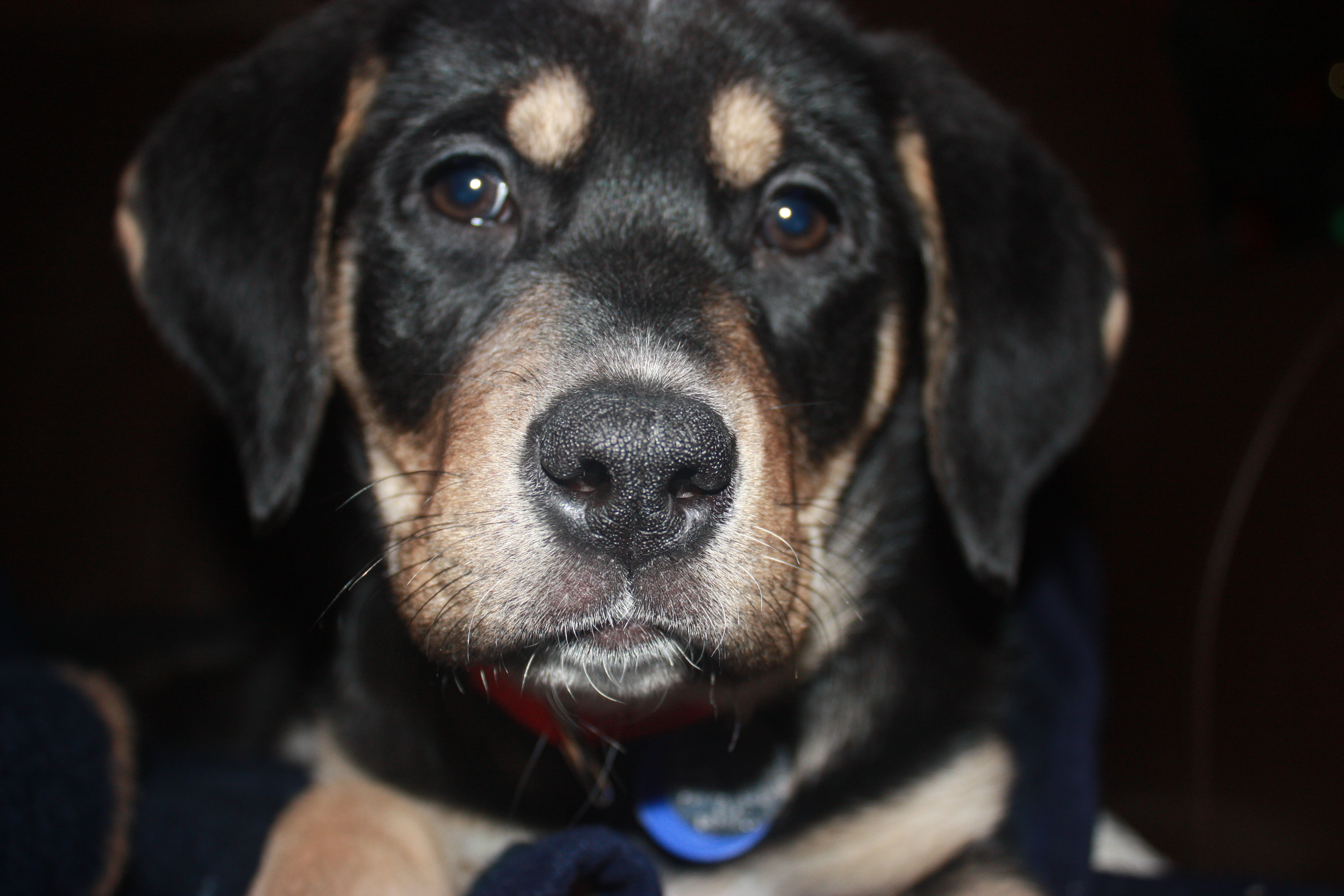
Boomer at 8 weeks old

The shelter named her Brandy Butter, but we named her Boomer, after a character on Battlestar Galactica.  (Back story: when he and I first started dating, one of our favorite things to do when we hung out was watch this show together.)

Two days after we adopted Boomer, or she adopted us, my hair fell out.  I vividly remember going into my bathroom, taking a pair of scissors, cutting off my shoulder-length hair because my scalp hurt like a mutha.  I stared at my reflection (and a crazy-looking woman looked back) for a couple of moments, and then I said aloud, “Fuck it.  Go downstairs and cuddle your puppy.”

015

This is me, cuddling a puppy.

During chemotherapy, Boomer wasn’t just a pet to me, she was a welcome distraction.   Before we adopted the dog, my brain was pretty much all cancer, all the time.   What if it’s really not Stage 1?  What if I can’t withstand chemo?  What if I go into anaphylaxis?  What if this is just the beginning and will never end?  When Boomer came into my life, I had to worry about her.  Did she need to go outside?  Is she hungry?  Wait, it’s way too quiet – what shit is she chewing up?

Boomer was a positive light in a very dark time.  Sometimes she tested the very little patience I had, but at the end of the day, she was a cuddle monster.   She followed me around (like a puppy, har de har har) and when I was crying because I was positive I just couldn’t take any more treatment, Boomer would just stare at me, head tilted in worry.

Why so sad, Mom?  You can just pet me, Mom?  I’ll make it better.

image201101240003

Boomer was also something positive I could talk to friends and family about during treatment.  I would tell them about my most recent treatment or surgery, but then I would tell them about the newest cutest thing the Boomer dog just did.  My Facebook status updates were half cancer, half puppy shenanigans.
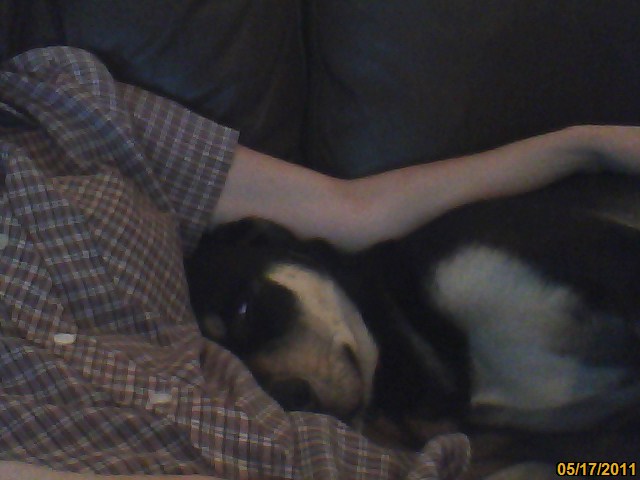
image201105170001

When I was recovering from chemo, Boomer was my reason to get outside and start walking.  If it wasn’t for her, I would have stayed inside much more than I did.  I’d get out of the house 45 minutes a day, or I’d take her to the dog park on the weekends.  She kept me from becoming a complete shut-in during chemo and radiation.

Me and Boomer after my double mastectomy

Me and Boomer after my double mastectomy

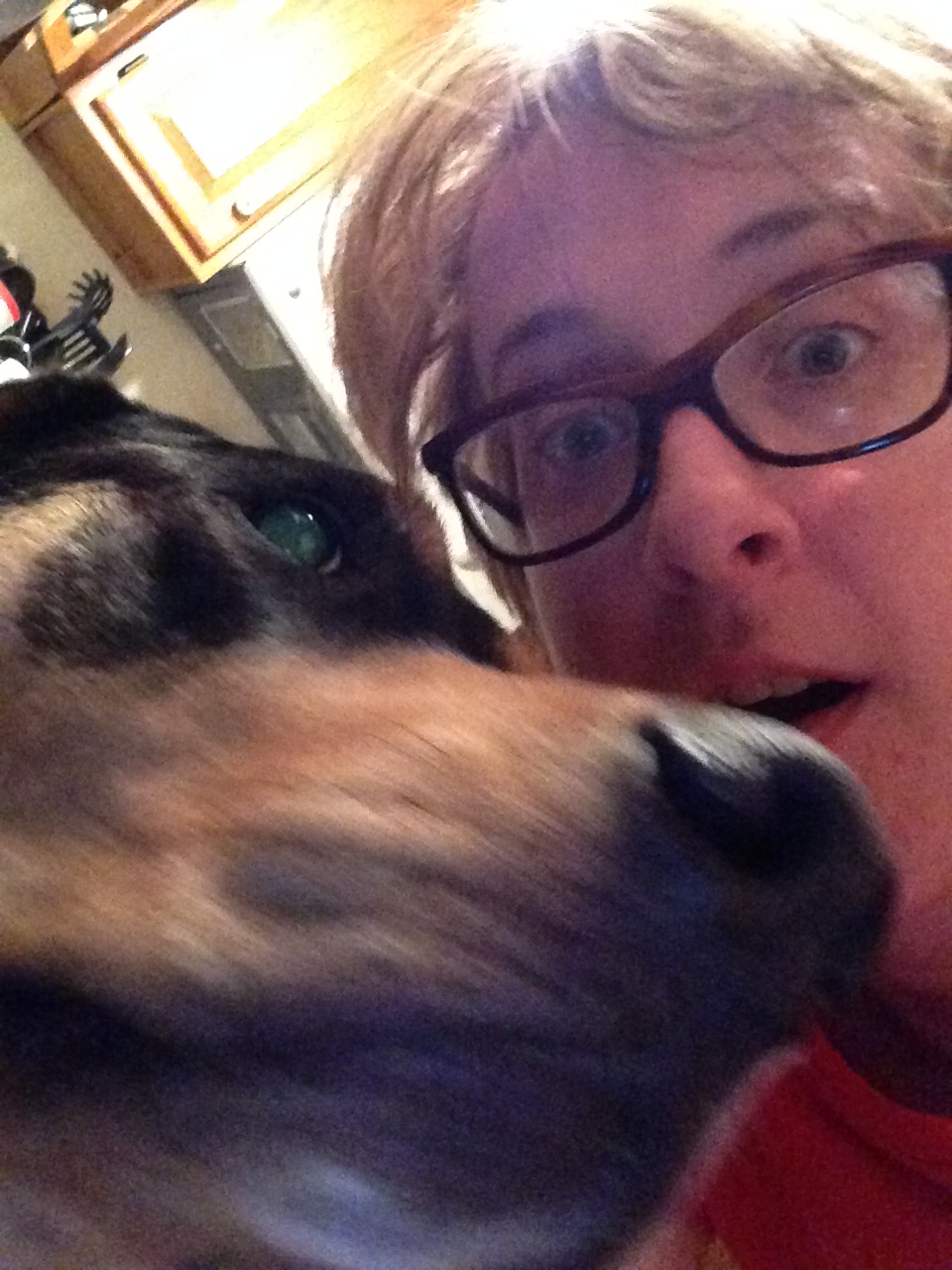
After my double mastectomy, I was on FMLA leave for six weeks.  Boomer kept me company while I slowly shuffled up and down my stairs and slept off my pain medication.   We posed for selfies, we slept on the couch and we went to the dog park when I had to get out of the house.

I don’t know if I’ll ever have children and sometimes, I don’t know if I want to have any children.  This might be the part where you think, “Oh great, she’s going to compare her dogs to children.”  Nope, not in the slightest.  Boomer and Mal are my beloved pets, and I adore them with everything I have.    I’m going to take as good care of them as I can until death do us part.   I love Mal, but Boomer is definitely special to me. Boomer is more than just a pet – she’s the creature that got me through two of the roughest years of my life.  She was my lifeline during treatment.

My mother, my inspiration

She is why I fight the Pink Ribbon culture.  She is why I throw away my bedazzled “survivor” sash and pink boa.  She is the reason why I want every one I know to think before they pink.  She is why I want to be a fearless friend for all those with metastatic breast cancer.   I love being NED and thank God every day for that and good health.  I want to be a part of the breast cancer discourse which sees us providing support to those with metastatic disease and abandoning awareness for the sake of awareness and the trivialization of a deadly disease.

My mother was more than a statistic.  She was a daughter, a sister, a cousin, a friend, a wife, a mother, a devout Catholic, an aunt, a social worker, a student…. She had a great life, and metastatic breast cancer was what killed her, not who she was.   I don’t remember my mother, but I’ll never stop wanting to make her proud.

Don’t disappear from the pictures

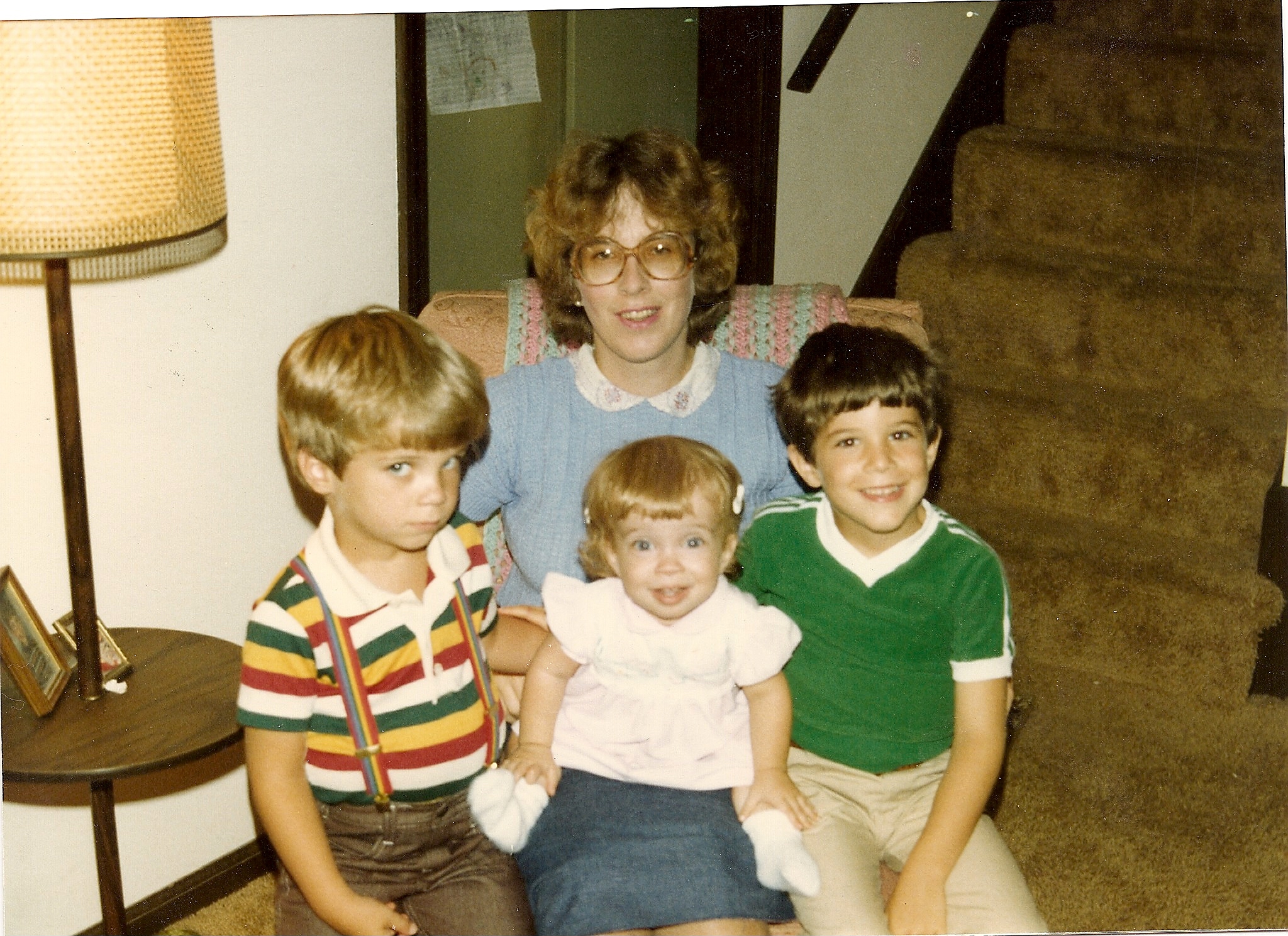
Whenever I talk about why research for metastatic breast cancer is so important for me, I typically post this picture, which was obviously taken when I was just a wee one.

Image

When I have mentioned that my mom died of breast cancer and then I post that picture, it recently dawned on me: “Huh, I wonder if anyone seeing this picture thinks that she died when I was a baby, not when I was in the second grade.”  That’s what got me wondering and subsequently asking my dad, “Hey, are there any pictures of just me and mom?”

My dad could only find two pictures, and it wasn’t any posed pictures of mother and daughter, it was two stolen moments that my father, an amateur photographer, caught.   He tried to explain why and how this happened, “Well, she didn’t like to have her picture taken.”  For the first time in a very long time, I felt really mad at my mother.

Someone reading this might think, “Well, the 80s were different.  It’s not like nowadays where everyone has a camera phone and it’s selfies 24-7.”  My dad has been an amateur photographer since his 20s, and he usually had his camera nearby.  My dad is the guy with the camera.  He sure as heck brought it to family events.  My mother dodged the camera.  She scowled and protested at my dad when he tried to take more pictures.   My mother was well known for her camera avoidance.

Image

Ever the peace keeper, my dad’s response when I expressed disappointment via email regarding the lack of pictures of mother and daughter: “Memories can be sharper than images.”  She died when I was 7 years old.   I do not have memories of her – they are more like snippets.   Plus, the snippets I have of my mother are from when she was sick from cancer treatment, not as the mother she probably wished I remembered her as.  Oxygen tubing, hospital visits, wigs.

As a 33 year old woman, the thought of being mad at my mother is so foreign to me.   Like, real, justified adult anger at a very deceased woman.  I feel pissed at her for not getting over her hatred of being photographed and just sucked it up.  I wished she would have said to my dad, “Hey, grab the camera.  Take a picture of Lara and me.”  Nope, she didn’t do that.  She ducked and dodged my dad’s camera like he was a landmine she didn’t want to step on.

In her defense, she was sick for a long period of my life from ages 2 to 7, but I would have still cherished a picture of my mom hugging me, showing some sort of maternal affectionate for her only daughter.  Some tangible proof that she was here and she loved her daughter, a daughter she worried (according to a friend of hers) would also have breast cancer.  I wouldn’t have cared in the slightest if I had pictures of my mother when she was sick if I was in the picture, too.  Her illness was a part of our lives, but I imagine that’s not something she wanted my dad to capture.

When she disappeared from the pictures, she disappeared from the events that took place.   One of the snippets I remember from a family vacation we took the summer before she died took place at a go-kart place in Panama City Beach, Fla.  My brothers were each driving their own go-kart, and I was in a go-kart with my dad (since seven years old aren’t allowed to drive those things).  My mother stood off to the side, watching us and hanging out by the railing.  She wasn’t participating, just watching.  When I think about that memory, it makes me sad because I have wondered if she was just disappearing right then and there.  My mother disappeared from my memory, and now she’s been this abstract figure in my life, as tangible as a dream.

My plea to parents, and this goes to anyone really, don’t disappear from the pictures.  Who cares if you think your hair is frizzy or you have a “weird” smile or whatever hangup or lie that we tell ourselves, and don’t want to be in the pictures?  When you have children, forget all that and just get into that picture.  Smile.   If you are the one usually taking the picture, because as the photographer at events I know how easy that can happen, then hand the camera off to someone!  Strangers are usually cool if you ask them, “Hey, can  you take a picture?”

I’m not 100 percent sure why my mother avoided having pictures taken while she was sick.  Maybe given her hatred of the camera before cancer just meant that the hatred multiplied by 100 after her diagnosis?  Maybe she thought if she didn’t let my dad take pictures of her bald or with a horrible wig on or other hospital-related scenarios, that we wouldn’t have to remember a horrible time in our lives.  Guess what, we still do.  Whatever it was, she did a disservice to me, her youngest child.  I was robbed of my mother, and then my mother robbed me of the ability to have a precious keepsake of just her and me.

Guilt

Last night I found out that a Twitter friend of mine, Jada, had died of metastatic breast cancer at the age of 35.  I stared at my screen – stunned.  Although her Tweets had shown a decline and nothing but bad news for her, it still felt like a punch to the gut to hear of her death.

Jada

Jada is not the first #bcsm friend of mine to have died of breast cancer.   Jen Smith, who wrote the blog Living Legendary, died of metastatic breast cancer in 2013, leaving behind a young son Corbin.  In her interview with Lisa Bonchek Adams, another metastatic breast cancer blogger and advocate, Jen said:

I know society and the media have conditioned us to use the language “battle” against cancer, or in the “fight/war” against cancer. This is something that I’ve never really felt connected to. After all, what am I battling? A rogue cell in my own body, so in essence, I’m fighting myself. The best quote I’ve found that relates to how I feel is when Elizabeth Edwards died in 2010. Her friend said, “Elizabeth did not want people to say she lost her battle with cancer. The battle was about living a good life and that she won.”

The other frustrating thing I run in to is “So-and-so tried XYZ therapy and was stable for 10 years, why haven’t you done that one?” Then I explain that I tried XYZ and had progression in 3 months. I think getting people to truly understand that this is such an individualized disease is key. Just because XYZ works for one person doesn’t mean all people will respond the same way.

And, this is just me, personally, but I hate being referred to as “sick.” I’m not sick; I have a disease called metastatic breast cancer. If I was “sick” that would imply that I’m possibly contagious or that I’ll get better, neither of which are true.

When I hear about another death from metastatic breast cancer, not only do I feel sadness but I feel guilty.  Why them and not me?  What did I do that they didn’t do?  What did I have in my favor that they didn’t?  Survivor’s guilt, I believe is the term for this feeling.  Jada was 35, and I’m going to turn 34 in two months.   I followed her Twitter feed and often thought: This could have been me.

This still could be me.

You see, my guilt is not just confined to survivor’s guilt.  Maybe it’s my Catholic upbringing or the fact that breast cancer has brought out all the feeeeeels in me.  Perhaps both?

I have felt guilty that my two years of health issues have severely postponed plans to start a family (or realistically, completely cancelled them altogether).   The idea of having children with someone like me, someone who can go from healthy to incredibly ill with little to no warning, is enough for The Boyfriend to reconsider having a family.  The thought of raising a child or children by himself is too much.  (Yes, yes, I know – nobody’s future is guaranteed, and I have heard: “But you can get hit by a bus tomorrow,” but a tragic accident versus a prolonged illness are two different scenarios.)   The Boyfriend has every right to be scared, as his feelings are valid.

In his defense, I have wondered if I should have children and possibly leaving young children behind without a mother, too, like how I grew up.  I wish I could tell him that it’s going to be okay, and we’ll never ever have to deal with cancer again.  I can’t.  I don’t know that.

I have felt guilty that I no longer want to talk, interact or even be in the same room as my step-family, thus creating a lot of stress and pressure on my dad.  His life is centered around this family, and I accept that.  I just no longer want any of them in my life.  I did tell him that if he ever was sick and needed me, I’d be down there in a heartbeat, and I wouldn’t be a dick to the step-family.  I won’t be fake nice or phony.  I know that my refusal to see the step-family as my family will cause stress and tension in get togethers, but I chose my path and I intend to stay on it.  I don’t see any of the steps apologizing to me.

Going through breast cancer treatment made me re-establish priorities in my life, and when I realized that people who were supposed to be my “family,” didn’t care about me, I cut them out of my life.  If someone doesn’t care about what happens to me when I have cancer, I don’t care about them.

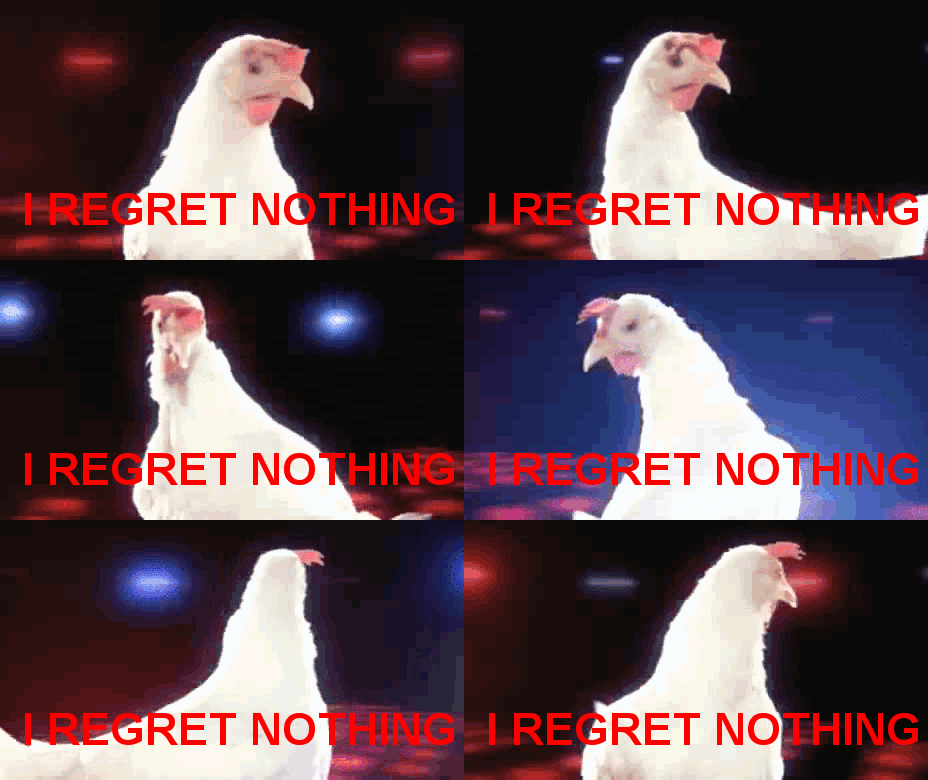
Iregretnothing2

I have felt guilty that I am not the pink ribbon loving, platitude spewing and survivor banner carrying woman who has had breast cancer.  I’m not that woman, and I often wonder if my refusal to play in the pink party has made others uncomfortable or downright afraid of me.  Initially after I was done with active treatment, I briefly flirted with the identity as a pink ribbon breast cancer survivor.  After learning the truth and reality of breast cancer and the pink ribbon, I walked the other way.  Ran, even.   That’s not the type of person I want to be after cancer.

(I do not fault anyone who wants to embrace the pink ribbon and the survivor label.  If it brings you peace and comfort, let it continue to do so.)

I have felt guilty that I haven’t become the Forever Changed woman who has had cancer.  I didn’t completely overhaul my diet and lifestyle.  Some individuals have changed their entire lives, and I’ve probably made a fraction of the changes.  Sure, I have started running and have pretty much cut alcohol from my life.  However, I couldn’t tolerate Tamoxifen and stopped after six months because the side effects were too much.  Every time I have come into contact with someone who takes Tamoxifen and also lives a BPA, paraben, chemical, sugar free life, I am overcome with guilt, feeling weak-willed.  I wish I was strong enough to have tolerated Tamoxifen or changed every aspect of my life. I think about my inability to take Tamoxifen often, often wondering if I doomed myself.  Then I feel guilty that I can put my loved ones through this again because I wasn’t strong enough.

Whenever someone I have made a connection with because of breast cancer dies from this disease, my heart hurts.  Jada was a beautiful woman, and her death just goes to show how much more work needs to be done.

RIP, Jada.Walt Whitman (1819–1892). Leaves of Grass. 1900.

166. O Me! O Life!

O ME! O life!… of the questions of these recurring;
Of the endless trains of the faithless—of cities fill’d with the foolish;
Of myself forever reproaching myself, (for who more foolish than I, and who more faithless?)
Of eyes that vainly crave the light—of the objects mean—of the struggle ever renew’d;
Of the poor results of all—of the plodding and sordid crowds I see around me;
Of the empty and useless years of the rest—with the rest me intertwined;
The question, O me! so sad, recurring—What good amid these, O me, O life?

Answer.

That you are here—that life exists, and identity;
That the powerful play goes on, and you will contribute a verse.

If you are a young, single woman just diagnosed with breast cancer.

This letter is targeted toward a young woman in her 20s or 30s – someone who isn’t married or has kids.  Someone like me.

To a young woman recently diagnosed with breast cancer,

I am so very sorry.  I wish I could tell you that everything is going to be okay, but I don’t know that.  Nobody knows, and I wish I could assail you with all the platitudes in the world, as if they could actually take shape and wrap you in a warm blanket, but that’s never helped anyone.  If you are looking for platitudes, then I am the wrong blogger for you.  (I truly believe that our language when it comes to cancer has become so superfluous and hyperbolic, veering drastically away from cancer’s reality.  I told the Boyfriend after hearing how I am such a “fighter” for the twelfth time that: “If one more person says I’m a fighter, I am going to straight up fight them.  Seriously, I will drop the damn gloves and take a swing.”)

https://twitter.com/xeni/status/423731770773618688

Nothing breaks my heart than hearing how another young woman joined the cancer club, where we are the minority.  According to the American Cancer Society’s Breast Cancer Facts & Figures 2013-2014, the median age for breast cancer between 2006 and 2010 is 61.  We’re a part of a club that is comprised of women the ages of our mothers, aunts and grandmothers.    The Young Survival Coalition’s website states:

In 2009, the American Cancer Society predicted more than 190,000 new cases of breast cancer in women. They estimated that roughly 18,600 of these women would be younger than 45.

The amazing Gilda Radner said it best:

Having cancer gave me membership in an elite club I’d rather not belong to.

Cancer in young women is so rare, but after you’re diagnosed, it seems to be something you hear about a lot more often.  Having cancer when it seems like most of your friends are getting married or having children can be one heart ache after another.  You’re in the hospital getting tests or scans, and you’re surrounded by those 15 to 20 years older than you.

My advice to any young woman who has been diagnosed with some type of breast cancer:

1.) Do not google your disease because typically, if you go looking for trouble, you’ll end up finding it.  Googling is not your friend when you are diagnosed with cancer.    If you are going to google, please take the advice from Andrew Griffith’s advice:

Google wisely. Google (and Wikipedia) are a reflex. Don’t fight it. However, when looking at suggested links, go for more reliable sources. Any national cancer (e.g. American Cancer Society, Canadian Cancer Society) or health agency (e.g., National Cancer Institute), major cancer centre (e.g., MD Anderson and others), and any specific cancer organization (in my case, the Leukemia and Lymphoma Society, and LLS Canada).

The internet can be the Wild Wild West, and anybody with internet access can post their crack-pot theories about cancer.  (“You can cure cancer with eating nothing but carrots!” or “.)  If you’re going to look for information, go to reputable websites.   A great source for information can be other women currently going through treatment or who recently went through treatment.  One place to find a great source of information would be the BreastCancer.org’s message boards.   You can find someone your age, or someone with your type of breast cancer, or another patient who lives nearby.

This is another great resource for information – the #BCSM community is amazing.  You will never find another group of individuals more passionate and focused not only on research, or awareness for the rarely talked about breast cancers, but helping other women (and also men) going through treatment.   If you have a twitter account, browse through the #bcsm hash tag, and you will be guided however you need.  If someone doesn’t know the answer, they may know someone who may know the answer.  I’ve befriended many people from the #BCSM community and my life has been the better for it.

Definitely, always and forever, take the advice of your medical team.  If you have any questions of something you have learned or come across, the best person to ask is your doctor.

2.) If you think you may want to have a child later down the road, please tell your doctor and get a recommendation for a great fertility specialist.  When you are diagnosed with breast cancer, sometimes you live minute by minute.  Hour by hour.  But you should look ahead and talk with a fertility specialist about your options because cancer treatment may take those options from you.   I discussed cancer and fertility a couple of months earlier.

3.) Lastly, this is something I wish I had done when I was first diagnosed – get thee to a counselor.  Don’t pass go.  Don’t collect $200.  Find help.  Find someone, like a therapist, or a support group, and take care of your mental health.  I made the mistake of thinking, “Oh I can handle this,” but I got so overwhelmed after my fifth surgery (i.e., the tissue expander exchange surgery) that I just collapsed.  To say it was bad would be the understatement of the year.  I could barely function either at work or in my personal relationships.  With the love and encouragement of my friends (one of who researched nearby therapists and found the one I still go to a year later), I went to a therapist and was able to learn how to deal with my post-cancer anxiety and depression.

I should have seen a therapist sooner, like as soon as I was diagnosed.  I truly believe that if I had, I may not have sunken so low after my fifth surgery.

Going through active treatment, you feel strangely safe and secure, even though you are living day-to-day in a passive role.  Every day, you are doing something to fight cancer.   Chemo kills all the bad cells!  Radiation zaps the cells!  Surgery removes the cells!  It’s a lot to process, to say the least.   Mental health is often overlooked while you’re going through treatment since the primary focus is on your physical being.

Depression and anxiety is so common after a cancer diagnosis.  Without the safety and security that active treatment gives you, you feel lost.  Alone.  Consumed with the thoughts: “What if it comes back?”  The Dana-Farber Cancer Institute website has great advice on how to cope with this fear:

Be informed.
Learning about your cancer, understanding what you can do for your health now, and finding out about the services available to you can give you a greater sense of control. Some studies even suggest that people who are well informed about their illness and treatment are more likely to follow their treatment plans and recover from cancer more quickly than those who are not.

Express feelings of fear, anger, or sadness.
Being open and dealing with their emotions helps many people feel less worried. People have found that when they express strong feelings like anger or sadness, they are more able to let go of these feelings. Some sort out their feelings by talking to friends or family, other cancer survivors, or a counselor. Of course, if you prefer not to discuss your cancer with others, you should feel free not to. You can still sort out your feelings by thinking about them or writing them down on paper.

Please, please please take good care of your mental health while you go through treatment.  If it’s online or in person, make time.   Asking for or seeking help when you’re diagnosed with breast cancer isn’t a sign of weakness.  It shows a real sign of strength.  Take care and be kind to yourself.

puppy5

Aside

Shame on you, Guardian US

Last night, the Guardian published a hit piece on Lisa Bonchek Adams, a woman who blogs and tweets about living with metastatic breast cancer. This is Lisa.

Unfollow


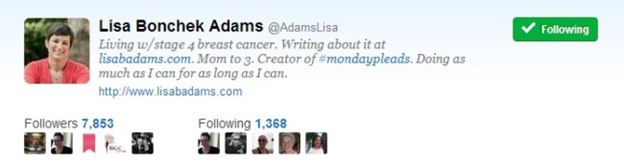
According to Lisa’s About Me page on her blog, she was originally diagnosed with Stage 2, Grade 3 breast cancer in October 2006. Six years later, Lisa learned that her cancer had metastasized to her bones, meaning she has Stage 4 breast cancer. Even though she underwent a double mastectomy, chemotherapy and the removal of her ovaries and Fallopian tubes. This woman did pretty much everything to reduce her risk of recurrence, and the cancer returned. Besides blogging, Lisa tweets about her health and treatment. As the picture above shows, as of January 2014, she has over 7,800 followers. I am one of those followers. I follow many women in the #bcsm (breast cancer social media) community.


When I heard about Emma G. Keller’s piece regarding Lisa and tweeting, I was livid. When I read this op-ed of Ms. Keller’s, I felt my blood pressure sky rocket. First, the headline and subheading were offensive:


LisaAdams


First, comparing a woman’s Twitter account to taking selfies at a funeral is just nonsensical and downright offensive. Lisa isn’t holding up her smartphone and taking cheesy pictures of herself in inappropriate places. She is telling her story and letting her readers know what is happening in her life and health.


Bitch, this is a selfie.


030


This made me livid:

She has been scrupulous about keeping track of her seven year decline. Her journey began with six month routine postpartum checkup after the birth of her third child. You can read all about the details of her disease and treatment on her blog right up until about this morning, which is when she posted her latest entry, only a few hours after the previous one.


Seven year decline? What the hell is this horseshit? She had early stage breast cancer, went through treatment, and then she was in remission until October 2012. There was no decline. For a journalist, shouldn’t you do something called fact checking? How about interviewing Lisa or those who know her?


This is my favorite part:


As her condition declined, her tweets amped up both in frequency and intensity. I couldn’t stop reading – I even set up a dedicated @adamslisa column in Tweetdeck – but I felt embarrassed at my voyeurism. Should there be boundaries in this kind of experience? Is there such a thing as TMI? Are her tweets a grim equivalent of deathbed selfies, one step further than funeral selfies? Why am I so obsessed?


I have a guess as to why she is so obsessed, and it’s a fact she doesn’t reveal in her hit piece on Lisa. Ms. Keller was diagnosed with DCIS in 2012.

But no, I was diagnosed with breast cancer on 5 January. Ductal Carcinoma In Situ, or DCIS as it’s known, is the fastest growing form of breast cancer today, thanks to new developments in mammography. But at Stage 0, level 1, it’s also the smallest, earliest form. (This is a cancer that, until recently, was known as “pre-cancer”.)


(I don’t know what she’s talking about when she says level. Maybe she means grade? This also demonstrates how little she apparently knows about breast cancer.)


You know what I find unethical? A woman who describes her bout with cancer as “my 40 day breast cancer” casting any negative light on a woman who will have breast cancer for the rest of her life. I suspect Ms. Keller is projecting her own fears that her DCIS diagnosis created in her. She asks why is she so obsessed? I don’t know, Emma – why don’t you unfollow Lisa and any other Twitter users with metastatic breast cancer if you can’t handle the reality they present?


I get it. I was diagnosed with Stage 1 invasive ductal carcinoma in 2010, and my biggest fear is a distant recurrence. When I feel a weird, unfamiliar back pain, I briefly wonder, “Is this a sign of mets?” That horrible nagging thought rarely leaves my side. Despite this fear and my anxiety about breast cancer, why do I keep following Lisa or Jada or Phyllis or Annie or Jude? Or why did I follow Jen Smith, who recently passed away from metastatic breast cancer?


I don’t think these (mostly) women with metastatic breast cancer should be ignored. Their voices should be the loudest in the breast cancer discourse, not those like Ms. Keller. They are the ones who live in three month increments, living life from scan to scan. They should be blogging, giving interviews and tweeting all they want. Instead of telling them to be quiet, let’s tell them to shout louder. Maybe, then, the ignorant (not rude, the real definition of ignorant) folks will actually listen. We need to be #fearlessfriends, allies to them, not trying to silence or shame them into being quiet. It’s bad enough that the month of October is basically a FU to those living with metastatic breast cancer. They should never be shamed into being quiet.


Ms. Keller, instead of obsessing over someone’s Twitter, maybe you should deal with the fact that there is no cure for breast cancer. Educate yourself. Your cells went rogue on you, and there is no guarantee that these cells won’t attack again. Since Lisa’s Twitter is creating too much anxiety or obsession or whatever this was, here’s a novel idea: hit this button.


Unfollow


It’s really not that hard.


You need to redeem yourself, Ms. Keller. Right now, you’re the writer who published a hit piece about a woman currently hospitalized from the disease I bet still gives you nightmares. Shame on you. Lisa should be concentrating 100 percent on her, not have to waste any energy on someone like you.a

Running

When I was in middle school and high school, I played sports but I was never good at them.  I probably would go as far as to say I stunk.  Pretty sure my family members who went to my softball games would also agree.  As soon as I turned 16 and could find a part-time job, I said good-bye to softball and began working at the local amusement park.

In an effort to get back into pre-cancer shape, at the recommendation of two dear friends, I joined this couch to 5K training group.  I had been pushing myself on the treadmill at my local gym in summer 2013.  Every time I pushed myself faster or longer, I felt so proud of myself, also fighting the urge to high-five other people at the gym.

High five me!  Come on, man!   I had breast cancer, and I’m recovering from months of reconstruction.  This is HUGE.

Both of my friends, who ran marathons and half-marathons, kept encouraging me to keep running but go beyond the treadmill.  Since they obviously knew what they were talking about, I listened and I’m glad I did.   Six months later, I just ran 5.5 miles on New Year’s Day with a group of runners, and I made good time.  Running to me is an individualized sport.  I’m at the point where I’m not trying to win in my age group.  I just want to improve my own time.  Sure, winning would be nice, but finishing the race is all that matters.

Image

Running has been the last step I needed to take for my recovery from breast cancer.  I am in the best shape of my life, and I’m not talking about post-cancer shape.  Right now, I am in the best shape of my pre- and post-cancer life.  I can run over 5 miles three times a week, which is definitely not something I could have said in 2009 or 2010.  Sure, I was thin and probably 10 pounds lighter than I am, but I was in awful shape.

Not anymore.

On top of the physical benefits, the mental benefits have been greater.  When I’m running, I’m not worrying about my job, my family, my relationship or what I have to do at home to keep it from turning into a pigsty.  While running, I think about my body, like where my arms are, bringing my knees up higher, making sure my hips are pulled in and my butt isn’t sticking out.  Running, for me, is like meditation.  My brain takes a breather while my body is being pushed to its limits.

Running also helps to reduce my risk of developing a new breast cancer or developing a distance recurrence (i.e., metastatic breast cancer).  Research after research shows that physical activity can lower your risk of breast cancer.  Sadly, nothing helps you prevent cancer, and I definitely do not believe that women who go on to develop a new breast cancer or metastatic breast cancer never exercised.  (Sorry health nuts, even healthy, in-shape people develop breast cancer.)  When it comes to cancer, we just don’t know.  The best we can do is lower our risk.

Recently, an October 2013 New York Times article published a piece regarding how walking may lower breast cancer risk:

Meanwhile, those few women who were the most active, sweating vigorously for up to 10 hours each week, realized an even greater benefit, with 25 percent less risk of developing breast cancer than those women who exercised the least.

A 25 percent risk reduction isn’t nothing to sneeze at, no sir.

A June 2012 Time piece discussed similar results and numbers.

For the study, researchers at the University of North Carolina at Chapel Hill compared 1,500 women with breast cancer to more than 1,550 women without breast cancer who were part of the ongoing “Long Island Breast Cancer Study Project” that looked at environmental causes of the disease.

The researchers found that women who exercised during their reproductive years or following menopause reduced their risk of developing breast cancer. The greatest risk reduction was found in women who exercised 10 to 19 hours per week (or two hours each day for five days), but a woman’s risk was reduced for all levels of exercise intensity, even light. Exercise appeared to reduce the risk of hormone receptor positive breast cancers, which are the most commonly diagnosed tumors among U.S. women.

That article mentioned “hormone receptor positive breast cancer,” as the most commonly diagnosed tumors.  Indeed, New York Times specified that er+ (the type of breast cancer I had) consisted of approximately 75 percent of breast cancer diagnoses.

I came across this Washington Post article written by a woman who also went through breast cancer treatment.  Elizabeth H. MacGregor wrote:

There was virtually nothing I could control about the nightmare of my cancer, I thought. But give me one thing that I can take charge of, that I can do — that I love to do — and I’m going to ride as if my life depends on it.

Ding, ding, ding.  That’s it, at least for me.  When it came to my cancer treatment, I had little to no control of what happened to me and what I had to endure.  Ms. MacGregor again wrote:

Some women are empowered by a cancer diagnosis, but I was not. I only felt vulnerable. While I trusted the medical professionals caring for me and the treatments I received, I found my role to be unsettlingly passive. Cycling allowed me to be an active participant in my treatment; it gave me agency in my recovery.

I took my doctors’ advice, and I underwent the treatment they suggested in an “unsettlingly passive” role.  Sure, I could have said no or kept looking for a doctor who would eventually tell me what I wanted them to tell me.  I went the conventional route with the conventional treatment, and I have no regrets.  The control aspect has come after treatment, and running is something I can control.  I decide whether or not I put my running shoes on.

While I don’t know if I’ll ever go through cancer treatment again, I at least know I’m making it harder for breast cancer to catch me.

With all this awareness, why are we still ignorant about cancer?

Early last week, I came across an article published on Scientific American which made me roll my eyes and say, “Of course.”  When Ms. Jolie announced her decision in the New York Times on May 14, 2013 that she had a double mastectomy because of her BRCA1-mutation, I naively thought, “Wow, she is like The Celebrity.  Maybe the general public will actually learn something about breast cancer for once.”  

I do not blame Ms. Jolie for the general public’s ignorance about breast cancer and its risks.  She did write in her op-ed:

Only a fraction of breast cancers result from an inherited gene mutation. Those with a defect in BRCA1 have a 65 percent risk of getting it, on average.

Nothing about what she wrote could be open for interpretation.  She explicitly wrote in her op-head that only a fraction of breast cancers result from an inherited gene mutation.  The Scientific American article unfortunately reveals that the general public believes otherwise.  

Researchers surveyed more than 2,500 men and women and found that a whopping three out of four knew Jolie’s story. But less than 10 percent could correctly answer questions about the BRCA gene mutation that Jolie carries. 

The myth that those who have this mutation or a strong family history (the category I fall under) make up the majority of who are diagnosed with breast cancer is prevalent.  According to the American Cancer Society’s 2013 to 2014 Breast Cancer Facts & Figures, which may be found here, an estimated 5 to 10 percent of breast cancers result from inherited mutations, including the BRCA1 and BRCA2 mutation.  

What does that mean exactly?  Well according to the ACS, this

Breast cancer risk is higher among women whose close blood relatives have this disease.

Having one first-degree relative (mother, sister, or daughter) with breast cancer approximately doubles a woman’s risk. Having two first-degree relatives increases her risk about three-fold.

The exact risk is not known, but women with a family history of breast cancer in a father or brother also have an increased risk of breast cancer. Altogether, less than 15 percent of women with breast cancer have a family member with this disease. This means that most (over 85 percent) women who get breast cancer do not have a family history of this disease.

I do not carry either BRCA mutation, but yet I still had breast cancer.  My mom was diagnosed with late stage breast cancer when she was 35, and then terminal breast cancer when she was 40 years old.  I was diagnosed with early stage breast cancer when I was 30.  There is no other family history of breast cancer in my family – it’s just the two of us.   Obviously there was a genetic link between my mother and I, but the genetic counselor did not uncover that link.

This Angelina Jolie Effect that the article cites just reinforces my belief that breast cancer awareness does not work, has not work and will not work.  If someone actually believes that Pinktober has saved lives, point me to the article stating that because I just don’t believe it.  We have this inaccurate perception that breast cancer is an easy cancer (is cancer ever easy?), or girly, or not something anybody dies from, which is the complete opposite of the truth.  Let’s abolish awareness or these campaigns because it has nothing to do with its actual truth or helping people.

Image


I prefer this:

Image


Race for the Agenda

(Originally posted on Get Up Swinging on February 2, 2012.)

I have spent the last two days really thinking about the decision of Komen to cut off funding to Planned Parenthood. It’s taken me that long to really think about what I want to say to the Komen foundation, and here it goes:

Shame on you. You have let me down, and you have forever lost me as a supporter for your organization.

I had been participating in Race for the Cure races since 2000 in honor of my mother. Several of those years, I walked in the Race by myself because it didn’t matter that I was alone. I was racing in memory of my mother. Mother’s Day used to be painful for me because my mom was gone. Race for the Cure helped me feel close to her on a day that used to bring me pain. I go to sleep in nights in Race for the Cure T-shirts. All those years, I believed that I was doing good and something that mattered. My mom was a social worker and worked for the United Way before she died. My mom cared about others and wanted to help. I don’t know much about the woman, but I know that.When I participated in last year’s Race for the Cure, I felt a sense of community and pride. I looked around and took in all the other pink shirts. I saw the various signs proclaiming SURVIVOR. I loved it. I felt that one word they say a lot to cancer patients: “Hope.” I felt it and believed it. I saw women who were decades-long survivor and it gave me faith that I’m not going to die in the near future.

Komen made a cowardly decision by using a lame excuse, “Oh well, we’re not going to fund organizations that are under investigation.” I think I would actually respect their decision more if they just outright said, “We no longer want to be associated with an organization that provides abortions. This is our stance.” Okay then. Fair enough. Don’t hide behind a lame excuse – own up to it. However, my first question: why partner up with Planned Parenthood in the first place? It’s not like they all of a sudden became a place for women to go to for abortion. If it wasn’t political when the partnership started, then why make it political now?

I’ve spent way too much time on Komen’s Facebook page and have engaged with some lovely trolls, who had horrible literacy skills and scientific know-how. In the last two days, I have learned the following:

1.) Abortions cause cancer

Apparently there’s a website called abortionbreastcancer.com which, shocker, tells folks that abortion causes breast cancer. Yeah, that website seems really unbiased. Was the domain “BullshitMumboJumbo.com” not available?

I’m going to go out on a limb and say that ACS’ website is devoted to helping fight cancer, not some political agenda.

The topic of abortion and breast cancer highlights many of the most challenging aspects of studies of people and how those studies do or do not translate into public health guidelines. The issue of abortion generates passionate viewpoints in many people. Breast cancer is the most common cancer, and it is the second leading cancer killer in women. Still, the public is not well-served by false alarms. At this time, the scientific evidence does not support the notion that abortion of any kind raises the risk of breast cancer or any other type of cancer.

2.) Birth control causes cancer

Let me refer you to the National Cancer Institute’s take on that.
3.) Women with no health insurance should just research harder for help if they are sick.

4.) By cutting ties with Planned Parenthood and taking away funding for screening, Komen now supports a pro-life agenda.

So by cutting off women’s access to cancer screenings and possibly delaying a cancer diagnosis…. that’s pro life? Whose life are we for here?


5) Poor women wanting free mammograms have this sense of entitlement.

Komen and Planned Parenthood are both charities. They are not the government. Implying that these people are trying to take advantage of the system is inaccurate and offensive. When folks give to charity, that implies they want to help others. When people in need go to charity for help, there should not be strings attached to that help.
6.) Breast cancer is a side effect of birth control.

Breast cancer is a disease. It’s not a side effect. It’s not punishment for being a slutty mcslut who sluts around. It’s a disease. It’s a disease that does not discriminate. It likes young women, old women, Democrats, Republicans, junk-food lovers, vegans, skinny women, overweight women. When you are a bald, sick individual fighting for your life, cancer does not care whether or not you donated to Planned Parenthood or stood outside its clinic showing pictures of aborted fetuses.

When a woman feels a lump in her breast, it is the scariest thing in the world. It’s the boogie man under your bed and hiding in your closet. When you have that mammogram and the doctor tells you that you have to come in for a follow-up, all the hairs on your neck stand up.

Women, no matter their socioeconomic status, should be able to get that lump checked out. By limiting their access to finding that help, I don’t find anything pro-life about that.

There are other charities out there, waiting for your help and donation. I suggest you find them.