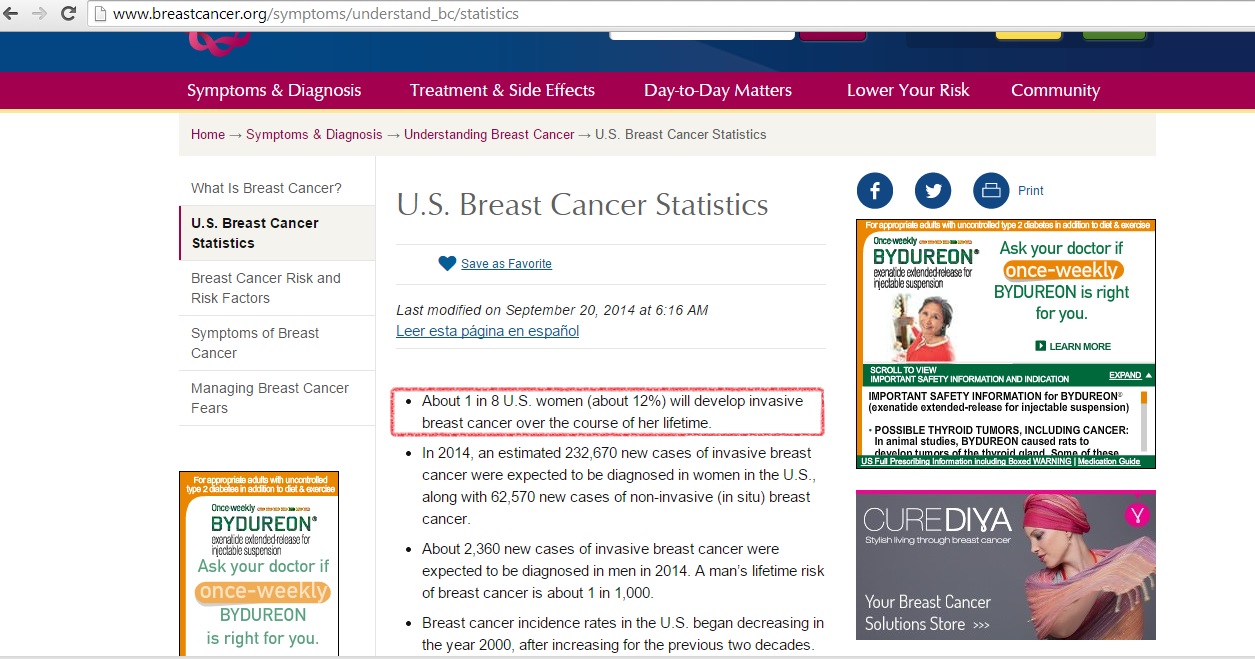
1 in 8

During this year’s Pinktober, did you happen to come across the “1 in 8 women will develop breast cancer in their lifetime” statistic?  Here are three screen caps with this statistic:

1in8-breastcancer.org

Now from the American Cancer Society’s website:

1in8-cancer.org

A Komen affiliate website:

 1in8

I actually learned recently that this 1 in 8 statistic is actually a teensy bit misleading.   Lifetime risk isn’t the same of your actual risk based on your age.  You know what blows my mind?  I found actual scientific information explaining this statistic on Susan G. Komen’s website (I know, knock me over with a feather):

Women in the U.S. have a “1 in 8” (or about 12 percent) lifetime risk of getting breast cancer [4-5]. This means that for every eight women in the U.S. who live to be age 85, one will be diagnosed with breast cancer during her lifetime.

Absolute Risk Komen

Source: Komen

So next time you come across the “1 in 8 women will develop breast cancer in her lifetime,” keep in mind the second part of that statement: “who live to the age of 85.”

I don’t know why charities and organizations use that statistic so much and with little explanation.  Maybe they want to scare people into thinking breast cancer is going to happen to everyone or maybe they don’t really understand the lifetime risk vs. absolute risk?

My friend AnneMarie, over at Chemobrainfog, wrote:

One in eight is a good springboard for a fundraising campaign.  It makes for a great way to terrorize those who do not understand that the number applies across your entire lifetime and it increases with age.  As you are seated around your table with eight family members of different generations or eight close friends, don’t try to figure out who, unless you also incorporate WHEN into the equation.

There are certain factors that increase your risk of developing breast cancer, and I fell in several of those categories: family history, dense breast tissue, certain benign (not cancer) breast problems and not having children (and related to that, not breastfeeding).  No doubt that these factors definitely increased my risk more than the 0.4 percent figure stated above.    Plus, now that I’ve had breast cancer, I’m also at an increased risk for developing breast cancer again.  Since treatment ended, I have made changes to my lifestyle, such as running and not drinking alcohol, among others, to minimize my risk because I never ever want to go through that again.

Cancer can often feel like a numbers game, although many doctors and specialists in the field will emphasize that you are an individual, not a stat.  When you fall on the bad side of these statistics, these numbers almost seem cruel.  I had less than one percent chance of going into anaphylaxis during chemo, yet that happened to me.  Cancer is definitely not something I ever wanted to be unique at.

I truly believe it’s important for us to know our risks and what we can do to minimize our risks for developing breast cancer.   First, we need to fight through the Pink Ribbon rhetoric seemingly designed to scare the general public with statistics without little or no context.

Guest Post from “Hazel Flatchest”

Here is a guest post from a woman who reached out to me.  Obviously her name is not Hazel Flatchest, but she wanted to remain anonymous. 

————————————————————————————————————————————————–

Breast cancer, you say?  Well, it is October…. That month when you walk into the grocery store and it looks like someone vomited Pepto Bismol all over the aisles.  So of course we want to talk all about breast cancer and awareness (gag!) and mammograms this month. Screw that.  Cancer is soooooo 2010.  Let’s talk about NOW.

The mastectomy scars have healed.  The port was removed.  The hair has grown back.  Everything should be back to normal, right? WRONG. WRONG. WRONG.  I don’t even know what “normal” is anymore.

But for the sake of argument, here’s my new “normal”:  I haven’t held down a full-time job for more than 3 months in over 4 years.  I cry several times a day.  Not out of sadness or depression (although I’ve experienced my fair share of both of those in the past four years…), but mostly out of sheer frustration.  I often feel as if I have lost my mind.  It is shrouded in a haze of chemo fog that has affected my ability to solve even the simplest of math problems or puzzles.  I can no longer multi-task without feeling stress and fear rise up from the pit of my stomach.  I am, quite simply, a hot mess.  And the worst part?  Having to accept that this is now my new “normal”.

A recent article on NBC News regales that “Women who get chemotherapy for breast cancer may end up unemployed for a very long time.”  I am living proof that this sentence is true.  And discussions with friends who also went through chemotherapy for this asshole disease only seem to uphold this statement.  Even friends who were employed throughout treatment and still hold those same jobs whisper of negative performance reviews and fears of losing their jobs.  So what the hell?  Seriously.  WHAT. THE. HELL?

Here are some observations of my own situation since I did 16 rounds of conventional chemotherapy and 2 years of Herceptin for my stage 2, asshole Her2 positive breast cancer:

1)    I get frustrated (and cry) easily.  It really doesn’t take much.  Just hand me a pile of things to do.  I used to be a consummate multi-tasker.  Now I just look at the pile and can’t figure out how to prioritize it into a reasonable workflow. So what do I do?  Well, sometimes I just cry.

2)    I am crippled by difficult problem-solving.  I recently took an aptitude test that included a “spatial reasoning” section – lots of puzzles and shapes where you figure out what comes next in a series of shapes and symbols.  After much consternation and nail-biting, I had to call a spade a spade and realize I was freaking myself out instead of arriving at the answers.  I actually could not finish that portion of the test.  I was just too stressed out to do it.

3)    I am extremely forgetful.  I have learned to write things down if they are important and need to be remembered.  This has been particularly hard for me to accept because B.C. (before cancer), I had a mind like a steel trap.  Now my mind seems to be riddled with giant holes that allow information to escape at record speed.

4)    I am socially inept.  This is an area of life that represents a true paradigm shift in my behavior.  Before cancer, I was a social butterfly and easily made friends.  Now I am unsure of myself and hesitant to start conversations with new people for fear I will appear stupid or desperate.

And that is just a short list of things I can come up with off the top of my chemo-addled head.  I am Jack’s chemically altered brain.  I am constantly frustrated, ashamed and humiliated by these changes in myself.  And horrified that they are getting in the way of me getting a job and putting back together some semblance of “normalcy” in my life.  Is this cancer’s dirty little secret?  Does anyone else feel the way I do?  Bueller?  Bueller?

If you are a young, single woman just diagnosed with breast cancer.

This letter is targeted toward a young woman in her 20s or 30s – someone who isn’t married or has kids.  Someone like me.

To a young woman recently diagnosed with breast cancer,

I am so very sorry.  I wish I could tell you that everything is going to be okay, but I don’t know that.  Nobody knows, and I wish I could assail you with all the platitudes in the world, as if they could actually take shape and wrap you in a warm blanket, but that’s never helped anyone.  If you are looking for platitudes, then I am the wrong blogger for you.  (I truly believe that our language when it comes to cancer has become so superfluous and hyperbolic, veering drastically away from cancer’s reality.  I told the Boyfriend after hearing how I am such a “fighter” for the twelfth time that: “If one more person says I’m a fighter, I am going to straight up fight them.  Seriously, I will drop the damn gloves and take a swing.”)

https://twitter.com/xeni/status/423731770773618688

Nothing breaks my heart than hearing how another young woman joined the cancer club, where we are the minority.  According to the American Cancer Society’s Breast Cancer Facts & Figures 2013-2014, the median age for breast cancer between 2006 and 2010 is 61.  We’re a part of a club that is comprised of women the ages of our mothers, aunts and grandmothers.    The Young Survival Coalition’s website states:

In 2009, the American Cancer Society predicted more than 190,000 new cases of breast cancer in women. They estimated that roughly 18,600 of these women would be younger than 45.

The amazing Gilda Radner said it best:

Having cancer gave me membership in an elite club I’d rather not belong to.

Cancer in young women is so rare, but after you’re diagnosed, it seems to be something you hear about a lot more often.  Having cancer when it seems like most of your friends are getting married or having children can be one heart ache after another.  You’re in the hospital getting tests or scans, and you’re surrounded by those 15 to 20 years older than you.

My advice to any young woman who has been diagnosed with some type of breast cancer:

1.) Do not google your disease because typically, if you go looking for trouble, you’ll end up finding it.  Googling is not your friend when you are diagnosed with cancer.    If you are going to google, please take the advice from Andrew Griffith’s advice:

Google wisely. Google (and Wikipedia) are a reflex. Don’t fight it. However, when looking at suggested links, go for more reliable sources. Any national cancer (e.g. American Cancer Society, Canadian Cancer Society) or health agency (e.g., National Cancer Institute), major cancer centre (e.g., MD Anderson and others), and any specific cancer organization (in my case, the Leukemia and Lymphoma Society, and LLS Canada).

The internet can be the Wild Wild West, and anybody with internet access can post their crack-pot theories about cancer.  (“You can cure cancer with eating nothing but carrots!” or “.)  If you’re going to look for information, go to reputable websites.   A great source for information can be other women currently going through treatment or who recently went through treatment.  One place to find a great source of information would be the BreastCancer.org’s message boards.   You can find someone your age, or someone with your type of breast cancer, or another patient who lives nearby.

This is another great resource for information – the #BCSM community is amazing.  You will never find another group of individuals more passionate and focused not only on research, or awareness for the rarely talked about breast cancers, but helping other women (and also men) going through treatment.   If you have a twitter account, browse through the #bcsm hash tag, and you will be guided however you need.  If someone doesn’t know the answer, they may know someone who may know the answer.  I’ve befriended many people from the #BCSM community and my life has been the better for it.

Definitely, always and forever, take the advice of your medical team.  If you have any questions of something you have learned or come across, the best person to ask is your doctor.

2.) If you think you may want to have a child later down the road, please tell your doctor and get a recommendation for a great fertility specialist.  When you are diagnosed with breast cancer, sometimes you live minute by minute.  Hour by hour.  But you should look ahead and talk with a fertility specialist about your options because cancer treatment may take those options from you.   I discussed cancer and fertility a couple of months earlier.

3.) Lastly, this is something I wish I had done when I was first diagnosed – get thee to a counselor.  Don’t pass go.  Don’t collect $200.  Find help.  Find someone, like a therapist, or a support group, and take care of your mental health.  I made the mistake of thinking, “Oh I can handle this,” but I got so overwhelmed after my fifth surgery (i.e., the tissue expander exchange surgery) that I just collapsed.  To say it was bad would be the understatement of the year.  I could barely function either at work or in my personal relationships.  With the love and encouragement of my friends (one of who researched nearby therapists and found the one I still go to a year later), I went to a therapist and was able to learn how to deal with my post-cancer anxiety and depression.

I should have seen a therapist sooner, like as soon as I was diagnosed.  I truly believe that if I had, I may not have sunken so low after my fifth surgery.

Going through active treatment, you feel strangely safe and secure, even though you are living day-to-day in a passive role.  Every day, you are doing something to fight cancer.   Chemo kills all the bad cells!  Radiation zaps the cells!  Surgery removes the cells!  It’s a lot to process, to say the least.   Mental health is often overlooked while you’re going through treatment since the primary focus is on your physical being.

Depression and anxiety is so common after a cancer diagnosis.  Without the safety and security that active treatment gives you, you feel lost.  Alone.  Consumed with the thoughts: “What if it comes back?”  The Dana-Farber Cancer Institute website has great advice on how to cope with this fear:

Be informed.
Learning about your cancer, understanding what you can do for your health now, and finding out about the services available to you can give you a greater sense of control. Some studies even suggest that people who are well informed about their illness and treatment are more likely to follow their treatment plans and recover from cancer more quickly than those who are not.

Express feelings of fear, anger, or sadness.
Being open and dealing with their emotions helps many people feel less worried. People have found that when they express strong feelings like anger or sadness, they are more able to let go of these feelings. Some sort out their feelings by talking to friends or family, other cancer survivors, or a counselor. Of course, if you prefer not to discuss your cancer with others, you should feel free not to. You can still sort out your feelings by thinking about them or writing them down on paper.

Please, please please take good care of your mental health while you go through treatment.  If it’s online or in person, make time.   Asking for or seeking help when you’re diagnosed with breast cancer isn’t a sign of weakness.  It shows a real sign of strength.  Take care and be kind to yourself.

puppy5

Aside

Shame on you, Guardian US

Last night, the Guardian published a hit piece on Lisa Bonchek Adams, a woman who blogs and tweets about living with metastatic breast cancer. This is Lisa.

Unfollow


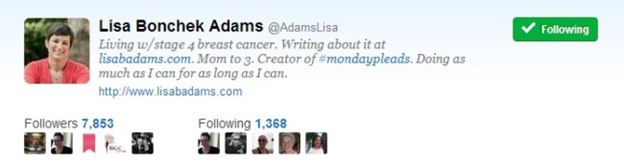
According to Lisa’s About Me page on her blog, she was originally diagnosed with Stage 2, Grade 3 breast cancer in October 2006. Six years later, Lisa learned that her cancer had metastasized to her bones, meaning she has Stage 4 breast cancer. Even though she underwent a double mastectomy, chemotherapy and the removal of her ovaries and Fallopian tubes. This woman did pretty much everything to reduce her risk of recurrence, and the cancer returned. Besides blogging, Lisa tweets about her health and treatment. As the picture above shows, as of January 2014, she has over 7,800 followers. I am one of those followers. I follow many women in the #bcsm (breast cancer social media) community.


When I heard about Emma G. Keller’s piece regarding Lisa and tweeting, I was livid. When I read this op-ed of Ms. Keller’s, I felt my blood pressure sky rocket. First, the headline and subheading were offensive:


LisaAdams


First, comparing a woman’s Twitter account to taking selfies at a funeral is just nonsensical and downright offensive. Lisa isn’t holding up her smartphone and taking cheesy pictures of herself in inappropriate places. She is telling her story and letting her readers know what is happening in her life and health.


Bitch, this is a selfie.


030


This made me livid:

She has been scrupulous about keeping track of her seven year decline. Her journey began with six month routine postpartum checkup after the birth of her third child. You can read all about the details of her disease and treatment on her blog right up until about this morning, which is when she posted her latest entry, only a few hours after the previous one.


Seven year decline? What the hell is this horseshit? She had early stage breast cancer, went through treatment, and then she was in remission until October 2012. There was no decline. For a journalist, shouldn’t you do something called fact checking? How about interviewing Lisa or those who know her?


This is my favorite part:


As her condition declined, her tweets amped up both in frequency and intensity. I couldn’t stop reading – I even set up a dedicated @adamslisa column in Tweetdeck – but I felt embarrassed at my voyeurism. Should there be boundaries in this kind of experience? Is there such a thing as TMI? Are her tweets a grim equivalent of deathbed selfies, one step further than funeral selfies? Why am I so obsessed?


I have a guess as to why she is so obsessed, and it’s a fact she doesn’t reveal in her hit piece on Lisa. Ms. Keller was diagnosed with DCIS in 2012.

But no, I was diagnosed with breast cancer on 5 January. Ductal Carcinoma In Situ, or DCIS as it’s known, is the fastest growing form of breast cancer today, thanks to new developments in mammography. But at Stage 0, level 1, it’s also the smallest, earliest form. (This is a cancer that, until recently, was known as “pre-cancer”.)


(I don’t know what she’s talking about when she says level. Maybe she means grade? This also demonstrates how little she apparently knows about breast cancer.)


You know what I find unethical? A woman who describes her bout with cancer as “my 40 day breast cancer” casting any negative light on a woman who will have breast cancer for the rest of her life. I suspect Ms. Keller is projecting her own fears that her DCIS diagnosis created in her. She asks why is she so obsessed? I don’t know, Emma – why don’t you unfollow Lisa and any other Twitter users with metastatic breast cancer if you can’t handle the reality they present?


I get it. I was diagnosed with Stage 1 invasive ductal carcinoma in 2010, and my biggest fear is a distant recurrence. When I feel a weird, unfamiliar back pain, I briefly wonder, “Is this a sign of mets?” That horrible nagging thought rarely leaves my side. Despite this fear and my anxiety about breast cancer, why do I keep following Lisa or Jada or Phyllis or Annie or Jude? Or why did I follow Jen Smith, who recently passed away from metastatic breast cancer?


I don’t think these (mostly) women with metastatic breast cancer should be ignored. Their voices should be the loudest in the breast cancer discourse, not those like Ms. Keller. They are the ones who live in three month increments, living life from scan to scan. They should be blogging, giving interviews and tweeting all they want. Instead of telling them to be quiet, let’s tell them to shout louder. Maybe, then, the ignorant (not rude, the real definition of ignorant) folks will actually listen. We need to be #fearlessfriends, allies to them, not trying to silence or shame them into being quiet. It’s bad enough that the month of October is basically a FU to those living with metastatic breast cancer. They should never be shamed into being quiet.


Ms. Keller, instead of obsessing over someone’s Twitter, maybe you should deal with the fact that there is no cure for breast cancer. Educate yourself. Your cells went rogue on you, and there is no guarantee that these cells won’t attack again. Since Lisa’s Twitter is creating too much anxiety or obsession or whatever this was, here’s a novel idea: hit this button.


Unfollow


It’s really not that hard.


You need to redeem yourself, Ms. Keller. Right now, you’re the writer who published a hit piece about a woman currently hospitalized from the disease I bet still gives you nightmares. Shame on you. Lisa should be concentrating 100 percent on her, not have to waste any energy on someone like you.a