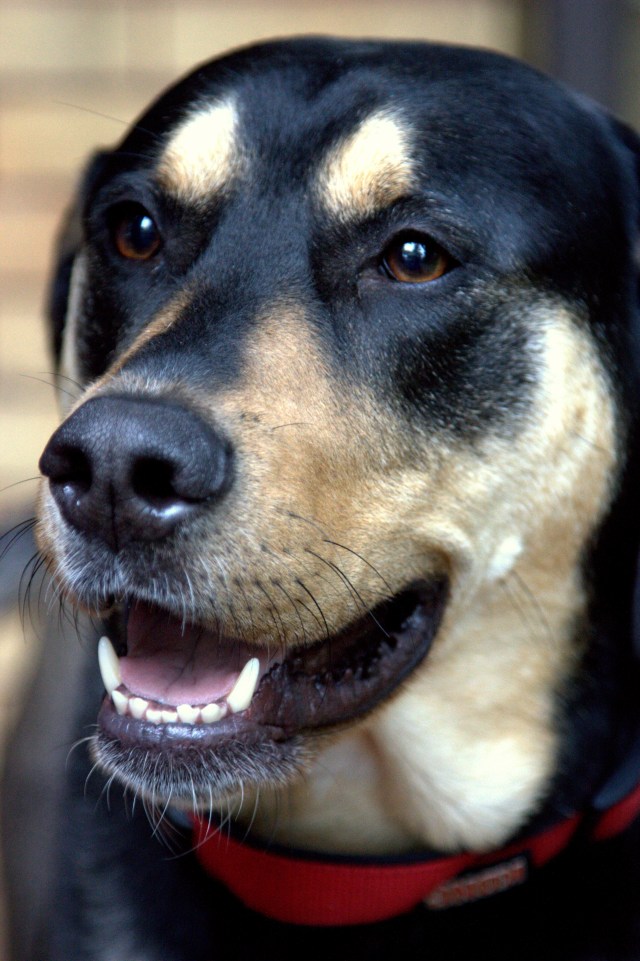
This is my baby, my heart. I love my Boomer girl.
This is my baby, my heart. I love my Boomer girl.
Look at this gem I came across Facebook awhile ago courtesy of Live Love Fruit, and I came the closest I have ever to that elusive rage stroke. (It’ll happen, my friends. It. Will. Happen.)
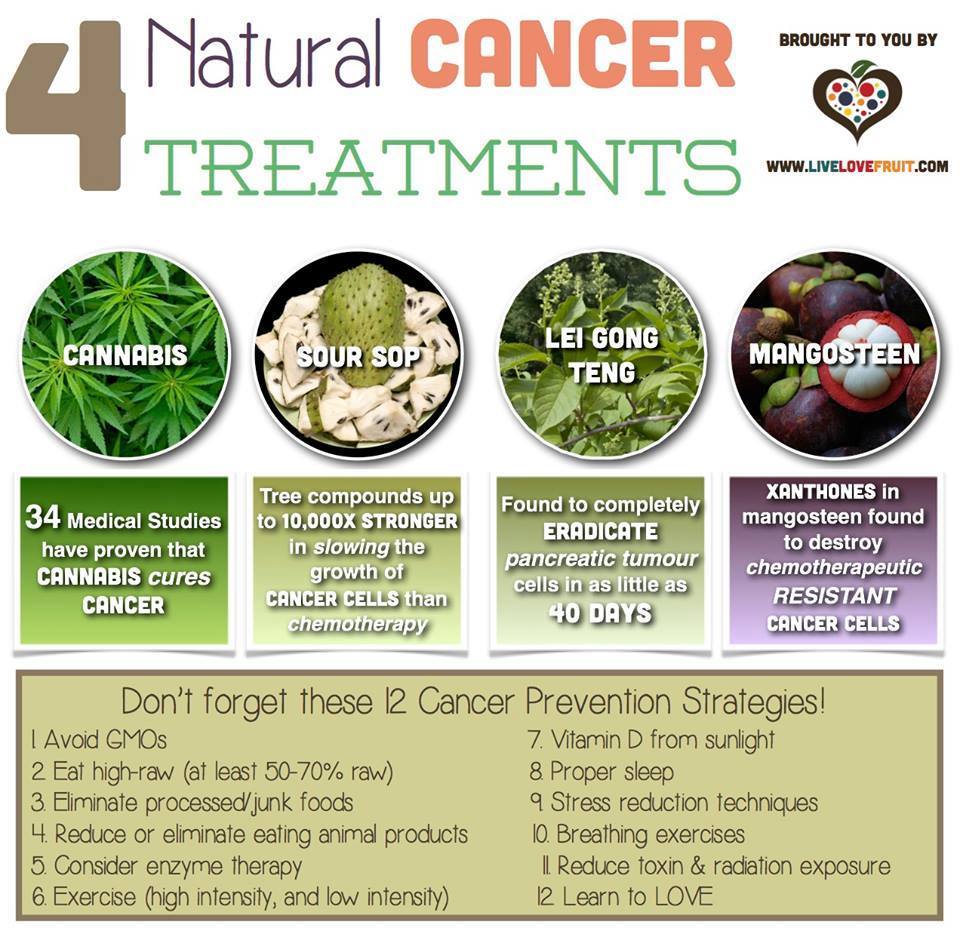
One of the many infuriating things about this graphic, disguised as health advice, is the fact that cancer isn’t just one disease. My breast cancer isn’t the same as the skin cancer that my dad had a handful of years ago. Hell, my breast cancer isn’t even like my friend N’s breast cancer (estrogen positive versus Her-2 positive). When these healthy living proselytizers start sticking their heads into serious, life and death, topics they know nothing about, that’s when my blood pressure wants to reach meteoric heights.
(Also, if you learn to love, you’ll prevent cancer? Seriously, what the actual fuck? So if you’re shooting figurative rainbows out your eyes and pooping bouquet of roses, you’ll prevent cancer? Oi. The stupid is strong with this one.)
Cancer, according to the National Cancer Institute, is defined as: “a term used for abnormal cells divide without control and are able to invade other tissues. Cancer cells can be spread to other parts of the body through the blood and lymph systems. Cancer is not just one disease but many diseases. There are more than 100 different types of cancer. Most cancers are named for the organ or type of cell in which they start – for example, cancer that begins in the colon is called colon cancer; cancer that begins in melanocytes of the skin is called melanoma.”
When I see graphics like this one, my first thought: what cancer are we talking about, ye ole wise Internet oncologists? Hmm, are we talking about carcinomas, sarcomas, leukemia, lymphoma and myeloma, or central nervous system cancers? Tell me, lady who juices and who believes Dr. Mercola is the best thing to happen to the Internet since cat videos, what cancer are you talking about? While we are at it, please show me all your diplomas from all the medical schools you attended.
I did a quick search for natural treatments to see just how effective they are. Here’s an abstract for a study entitled: “Alternative Therapy Used as Primary Treatment for Breast Cancer Negatively Impacts Outcomes.” Another study: “Effect of complementary and alternative medicine on the survival and health-related quality of life among terminally ill cancer patients: a prospective cohort study.” There are more studies out there, and this should go without saying for anyone diagnosed with cancer: discuss health plans with your team of doctors and for the love of pete, don’t take advice from people on the Internet.
I am not against alternative treatments in general. Not at all. I am against alternative treatments being used in place of the standard and tried-and-true treatments. I have heard and read that yoga, acupuncture, things of that nature, have helped loads in dealing with symptoms from treatment. I wholeheartedly believe those who are sick and want to try different ways to lessen their pain should try to find whatever works, and I hope you are successful.
The other main issue I take with the above graphic is the use of “prevention.” You can’t prevent cancer. You know what you can do, though? You can reduce your risk of certain cancers. When these Internet oncologists (who, I presume, received their Internet degree after successfully completing the course: “I read one article, and now I’m an expert”) throw around the word prevent, they perpetuate the false notion that if you just follow the Healthy Living Rules, you’ll never be sick.
A very gifted blogger, Stacey, explained exactly why the distinction of “prevention vs. risk reduction vs. screening” needs to be made in this fantastic CoffeeMommy blog post:
Why is the terminology distinction important? Three reason bubble to the top for me:
Continued Diligence: Individuals must remain diligent in personal and professional screening even when they “do everything right” on the risk reduction list. Mammograms don’t “Save the ta-tas” they simply alert people as to whether or not their breasts are trying to kill them. I can personally attest to the fact that people who follow all the published rules for how to prevent breast cancer, and get a mammogram at 40, still get breast cancer.
Removing Stigma and Eradicating Blame & Shame: According to anecdotal data, the most common question lung cancer patients field is, “How long did you smoke?” If you advertise risk reduction as prevention you are perpetuating a falsehood. Perpetuating the idea that cancers are preventable implies that, when a diagnosis is given, somebody did something WRONG.
Redirecting Research Focus: While a list of ways to reduce risk for disease is helpful, such a list is not a magic bullet. Already genomic research is leading to personalized treatments. We need to expand efforts in this area. When the general public finally realizes that no one is “immune” to a cancer diagnosis, more focus can be applied in the appropriate areas.
Actors who are in the best shapes of their lives are diagnosed with cancer and die. Athletes get cancer. Never-Smokers get lung cancer and die. Vegetarians also get cancer. Oftentimes biology and/or environmental factors are too big of obstacles for a healthy lifestyle to shield you from anything bad, and you can get sick. You cannot prevent cancer. You can reduce your risk. I am sorry to burst any bubble, but bad things can happen to good people, including healthy people.
Oftentimes you see these graphics, like the one above, being shared and posted by those who have never had cancer or faced any medical hardship (as a result of that, they seem to think they have the human body all figured out). Frankly, I think it’s irresponsible and downright dangerous to be advocating for a “natural cancer treatment” when it’s not YOUR life at stake. People have said to me, “Man, I don’t know if I could do chemo if I had cancer. That just seems really drastic, all that poison.”

My response: “Oh yeah, total poison. Nothing good or easy about it, but man, when the doctor told me I had breast cancer, I couldn’t get hooked up to that IV quick enough.” Let’s make a deal, internet oncologists. If YOU come down with cancer, then you should try the natural cancer treatments, and report on how that worked out for you. In the meantime, I’m going to listen to those in the medical field who actually do know what they are talking about.
You also see a lot of this line of thinking in social media land after you have become a sickie:
 ‘
‘
To the folks who subscribe to this paranoid Big Brother attitude, I applaud you for the privilege of not ever having been sick and needing medicine to actually stay alive or to function. I’m not exaggerating either – needing real medicine, and not some essential oil or some fruit that people in South America supposedly do instead of chemo, to stay alive. It must be nice. If it wasn’t for big Pharma, I’d either have advanced disease or I’d be dead. Who knows? I wouldn’t be living a No Evidence of Disease life right now, and I certainly wouldn’t have run a half marathon not even a month ago. If this makes me a so-called Big Pharma pawn or whatever it is that these theorists think I am, so be it. I know I’ll rest easy tonight.
I did it. I freaking did it.
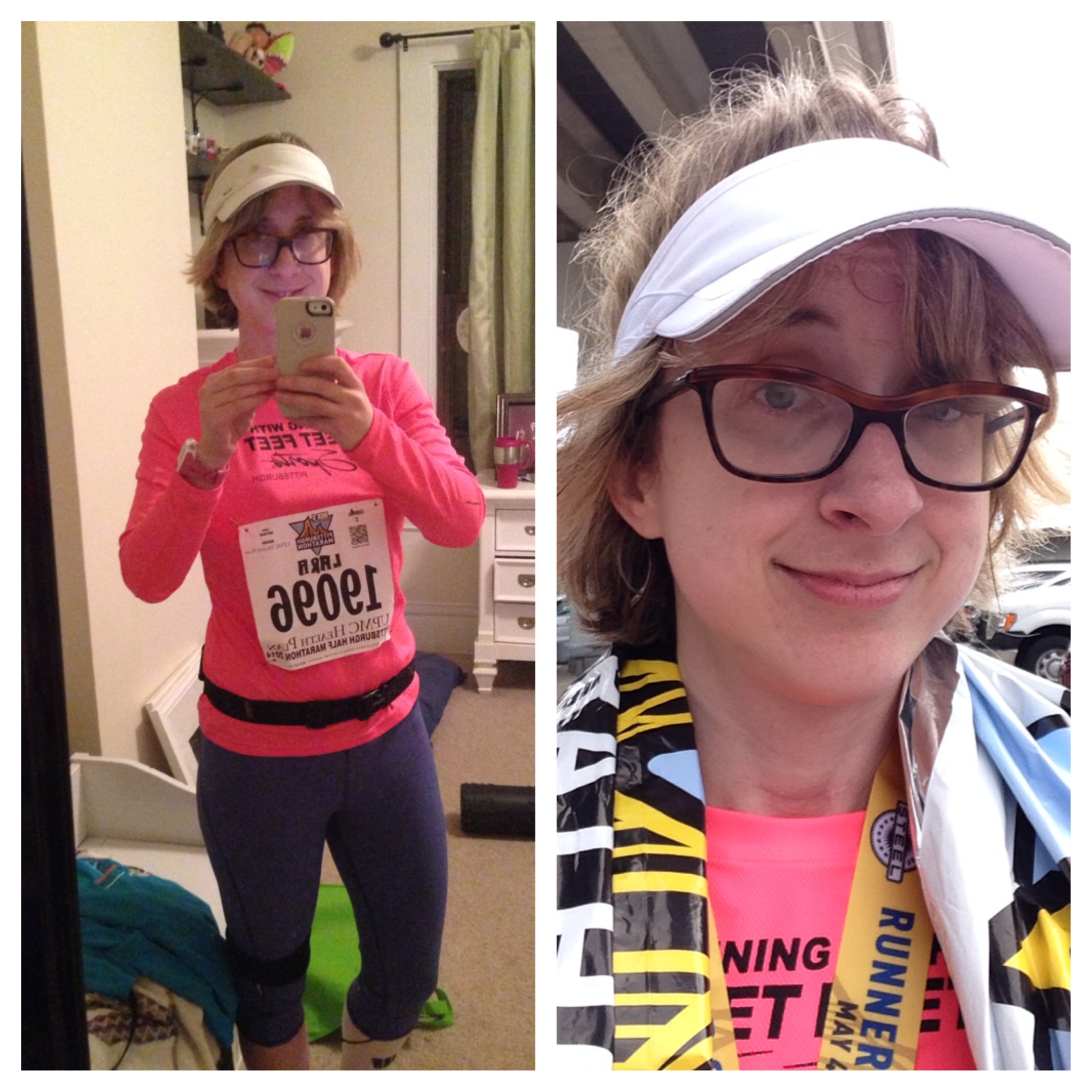
Pre-race selfie and post-race selfie
I ran 13.1 miles today, and I didn’t stop to walk. (I did stop for water breaks, but I’m not counting that.) I’ve been training for this day for months, basically since last October. This time last year, I was still recovering from five surgeries over the period of two years. I was 10 to 15 pounds heavier, and I lacked direction. I didn’t know how to change my life and bounce back from all the crap done to me during breast cancer. I hated what cancer had done to me physically with all my scars, weight gain and the reconstruction.
I’m now in the best freaking shape of my life. I have never looked and felt like this, even before cancer. I have a feeling of purpose with running. During all my treatment, I remember how absurd it felt to hear people say to me, “Oh, you’re so strong. You’re a fighter.” That always struck me as odd because I had never felt so physically weak and just beat up. Like, seriously, who was I fighting and winning? Cancer treatment puts the patient in a very passive role. I didn’t do anything – rather, treatment was done to me.
I feel strong now, and I have realized that I’m not strong nor was I ever strong because I had cancer. I am now strong even though I had cancer.
During the last three or four miles of the race today, I actually started getting flashbacks to my time in the chemo ward. I could see myself in the chair, looking out at the other patient. I remembered that feeling of helplessness and hopelessness. I’d snap out of that flashback and just ran harder. Then I flashed to my hospitalization after my double mastectomy, and how much pain I felt. I’d snap out of that, too, and ran harder. It was like Runner Lara was running like hell away from Sick Lara, like I am finally able to put that period of life behind me (knowing damn well that it can always come back).
Nothing I can do will prevent breast cancer from ever coming back, either local or distant. What I do today, like putting on a pair of shoes and running, is what i can do. That’s the only control I have – this very moment.
This race was such a huge deal to me. It was to see if I could even do it and a big fuck you to cancer. Now it’s done and in the (Lara) record books, it’s time to move on. I’m definitely not cancer girl anymore.
I am a runner.
I recently just “met” Kerry through another friend of mine, Michele, who has had breast cancer and runs races. I am meeting a lot of women who’ve had breast cancer and who are also runners – awesome! Anyway, here’s Kerry’s story.
Name: Kerry

Type of cancer and treatment:
Dx Oct 2008 @ 42 yrs, IDC, Stage IIIa, Grade 3 [ed note: breast cancer, for those who don’t know what IDC means – invasive ductal carcinoma]
Right Mx, no recon
FEC-T x 6
25 rads
Tamoxifen
Ooph
Arimidex (still taking)
3 years of Zometa, 2 x a year
Were you a runner before cancer?
No. I was always really active; I walked everywhere, hiked, canoed, gardened, etc, but hadn’t run since high school.
While I was in the middle of chemo, I decided I wanted to work hard at getting physically strong after I was done. Running seemed like an obvious choice. Chemo hit me quite hard. FEC made me throw up, and Taxotere gave me terrible bone pain, from which I was basically bedridden for a couple of days each round. I remember lying in bed feeling so terrible, so weak, and just wishing that I could feel strong again. I ended up hospitalized after my 5th round of Chemo (febrile neutropenia) and remember being taken from the ER up to a ward. There I was in a hospital gown, bald, IV pole, in a wheelchair, and I’ll never forget the look of pity and fear on the faces of people we passed. I never wanted people to look at me that way again.
I also did a lot of research about what I could do to increase my odds of survival, and time and time again I read that exercise would lower my risk of recurrence. It seemed like a no – brainer to prioritize exercise after active treatment ended.
I am also on an AI, one of the most common side effects is joint pain. I read one of the best ways to prevent this is, again, exercise. I do feel a difference in my body if I go a couple of days without running. I went through early menopause right after radiation, when I had my ovaries removed. I hope that running helps counter some of the negative long term cardiac effects of that, and some of the long term effects of chemo.
Did you run during treatment? How long after did you take it up?
I didn’t start running until after treatment ended. I walked during chemo, as much as I could, which towards the end was often just walking my kids to school and back. After chemo I started walking longer distances, and about 6 months after I finished up everything I started running a bit. (I live in Canada and had to wait for the snow to melt) I started off running small distances during my walks, and slowly increased how much I ran, until I was comfortably running 3 miles at a time. On a whim I decided to try and run 6 miles, which I did! Not long after that I decided to train for a half marathon, and about 7 months after starting running, (about 2 years after diagnosis) I ran my first half marathon. I have since run 2 more half marathons, and next month will run my 4th full marathon.
How has running helped you during and/or after treatment, both physically and mentally.
Physically and mentally it has made me so much stronger. I truly think running is saving my life, and my sanity. I came out of treatment with some extra steroid weight, feeling pretty weak and hammered by everything. Emotionally I felt quite vulnerable, it is such a shocking thing to happen, and I was not particularly hopeful about my long term survival. I think that when you are in the midst of active treatment you are in fight mode, but afterwards I think running gave me something positive to focus on, like I was still doing something to fight the cancer.
I also think that having gone through some pretty aggressive treatment, that cancer has helped me as a runner. I have often thought during a hard run, if I can get through chemo, I can get through this. I think it has given me the strength to not quit when the going gets tough.
What did your doctor say about your running?
My onc says it’s the reason I am doing so well. He is totally supportive.
What is your biggest challenge running after cancer?
Ha, well, I didn’t have recon, and sweat and a silicone prosthesis don’t mix! I had a couple of near embarrassing situations before switching to a foam prosthesis. It makes me look a bit lopsided if you looked closely, but I really don’t care.
I have had bursitis twice in my heels which I blame (possibly unfairly) on Arimidex.
I also have had occasional hand lymphedema after very long runs.
What would you say to someone just out of treatment who may be intimidated to take up running?
Well, I would say to start slow. You don’t have to be out running marathons. There is a huge benefit of just exercising for 30 minutes a day. Consistency is the most important thing. Start out with an easy, non-threatening plan, something like couch to 5k. Don’t worry about speed, don’t be afraid to walk. Just get out there and do something. Think of exercise as a key part of your treatment plan, the survival benefit is similar to chemo. And it’s far more fun 😉

Welcome to the inaugural post for what I hope can become an inspirational series about running during and/or after cancer – Get Up Running. This should go without saying but if you’re recovering from cancer and want to start running, clear everything with your doctors beforehand.
My first friend to respond to my inquiry was Marjie from Pink and Pearls. This woman has the kindest soul I have ever encountered, and I am so privileged to count her as a friend.
Name: Marjorie Miller
Type of cancer & your treatment:
Breast cancer; surgery (I also had childhood Leukemia at the age of 12, and for that, three years of chemotherapy).
Were you a runner before cancer or any other sports before cancer?
I ran my first 5K literally the same day I found a breast lump. (race that morning, found the lump in the shower that afternoon). I started running a few months before diagnosis, but was never a runner before cancer.
Did you run during treatment? If no, how long after treatment ended did you take up running?
Yes, I tried to run in between surgeries. I had six total surgeries, including a double mastectomy with reconstruction and lat flap. After each surgery when I got the go-ahead from my doctor to resume physical activity, I attempted to run again. It didn’t always happen with the expanders but I tried.
How has running helped you during and/or after treatment, both physically and mentally?
Mentally it helps me feel like I have control over my body again. It helps me feel in control of my health and my life. Breast cancer took my breasts but it can’t take what I do with my body, which is running. When I run it’s just me and my body; I have complete control. I take myself as far as I want. I push myself as much as I can. Nobody else gets a say when I lace up my sneakers. Physically it’s made me stronger and healthier. It gives me so much self confidence. It gives me energy, helps me deal with stress and anxiety, and I feel it keeps me sane 😉
What did your doctor/doctors say about you running?
They applaud it and encourage it.
What has big your biggest challenge running after cancer?
Being comfortable with the implants. My chest still feels tight and I am still regaining muscles under my chest wall. Running sometimes hurts and pulls at my chest.
What would you say to someone ending treatment or just out of treatment who might be intimidated to take up running?
Take it slowly. Take it one day at a time. Start with what YOU feel comfortable doing. Remember: when you run, you run for you and nobody else. My husband said to me before my first 10 miler a few weeks ago: “Just run YOUR race.”
You’re only running for yourself. Not to impress anyone else. Start with walking, slow jogging, taking breaks, whatever you need. You’ll find with time your energy and stamina will grow. Your confidence will grow. It does get easier and the more you do it, the more you love it.
Run happy!
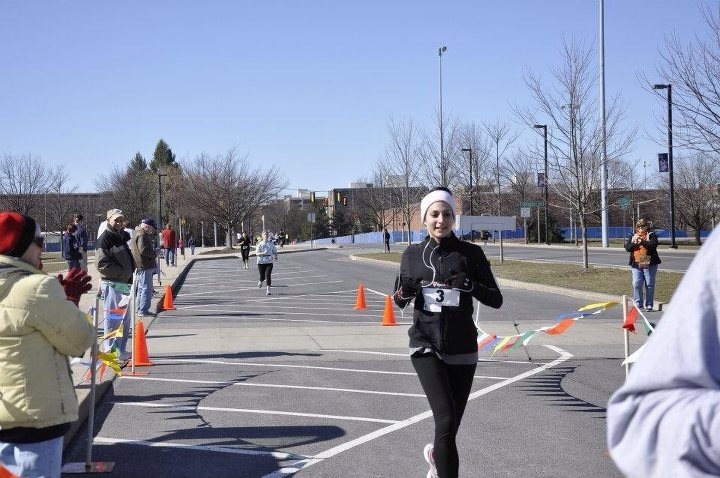
On Sunday, I accomplished something I never thought I could do – I ran 11 miles in two hours and three minutes. When I began Fleet Feet’s No Boundaries program last July, I wasn’t even sure if I could run a 5K. I thought to myself, “Okay, you signed up. That’s the first step.” I ran the Pittsburgh’s Great Race 5K in 31 minutes, and I was so proud of myself afterward. When I saw that Fleet Feet was offering a training program for either the half marathon or full marathon, I hemmed and hawed about it for days.
No way I can run 13.1 miles. You are out of your damn mind.
After I shook those “I can’t” thoughts out of my head, I signed up for the training group, and I have no idea why I ever thought I couldn’t do this. Now that I have an 11 mile run under my belt, I know that I can run the Pittsburgh Half Marathon this May 4. I am going to do it. Even more so, I am going to run the Pittsburgh Half in two hours. That’s my goal. Whether or not I meet that goal, I’m going to be proud that I crossed that finish line.
Cancer is something that my body does. Running is something I choose to do.
When I cross that finish line in just over a month, I hope my mother is looking down from wherever she is, shouting, “HUFFMAN RULES.”
In the months prior to my diagnosis, the Boyfriend and I had been discussing when it would be a good time to get a dog. One of the many reasons we had bought the house earlier that year was its double lot – perfect for a dog. For about five months after moving into the house, we devoted most of our time and energy into clearing up the backyard, which the previous owners apparently forgot was a part of their home. Weeds, years of un-raked leaves, literally garbage behind the detached garage, and so many “garbage” trees and a fence falling apart.
Once we got that all cleaned up, the next step was a dog. However, that fall, I was diagnosed with breast cancer.
Two months into my treatment – including the initial shock, lumpectomy and beginning chemotherapy, I had come to the conclusion: it’s not a good time to get a dog. I couldn’t see managing a dog, working full time and undergoing treatment for cancer. Even though I was working from home, I still thought it would be a terrible idea to get a dog.
When the Boyfriend called me from the local animal shelter in mid December because he couldn’t think of a Christmas gift for me and somehow found himself at this shelter, I didn’t protest at all. In fact, I forgot about all the reasons why I shouldn’t get a dog, and all I could think was:
omgpuppiesomgpuppiesomgpuppiesomgpuppies
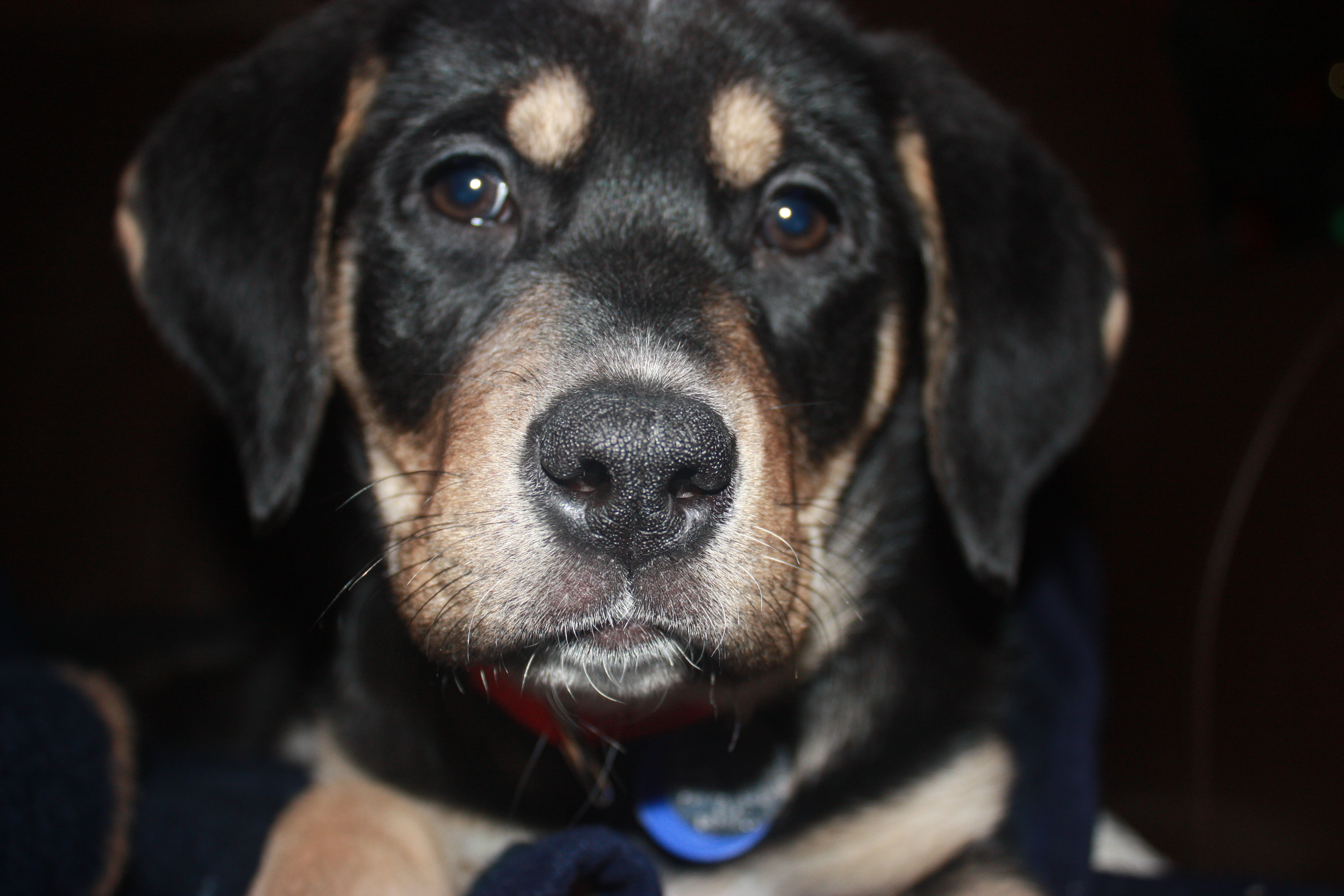
Boomer at 8 weeks old
The shelter named her Brandy Butter, but we named her Boomer, after a character on Battlestar Galactica. (Back story: when he and I first started dating, one of our favorite things to do when we hung out was watch this show together.)
Two days after we adopted Boomer, or she adopted us, my hair fell out. I vividly remember going into my bathroom, taking a pair of scissors, cutting off my shoulder-length hair because my scalp hurt like a mutha. I stared at my reflection (and a crazy-looking woman looked back) for a couple of moments, and then I said aloud, “Fuck it. Go downstairs and cuddle your puppy.”

This is me, cuddling a puppy.
During chemotherapy, Boomer wasn’t just a pet to me, she was a welcome distraction. Before we adopted the dog, my brain was pretty much all cancer, all the time. What if it’s really not Stage 1? What if I can’t withstand chemo? What if I go into anaphylaxis? What if this is just the beginning and will never end? When Boomer came into my life, I had to worry about her. Did she need to go outside? Is she hungry? Wait, it’s way too quiet – what shit is she chewing up?
Boomer was a positive light in a very dark time. Sometimes she tested the very little patience I had, but at the end of the day, she was a cuddle monster. She followed me around (like a puppy, har de har har) and when I was crying because I was positive I just couldn’t take any more treatment, Boomer would just stare at me, head tilted in worry.
Why so sad, Mom? You can just pet me, Mom? I’ll make it better.

Boomer was also something positive I could talk to friends and family about during treatment. I would tell them about my most recent treatment or surgery, but then I would tell them about the newest cutest thing the Boomer dog just did. My Facebook status updates were half cancer, half puppy shenanigans.
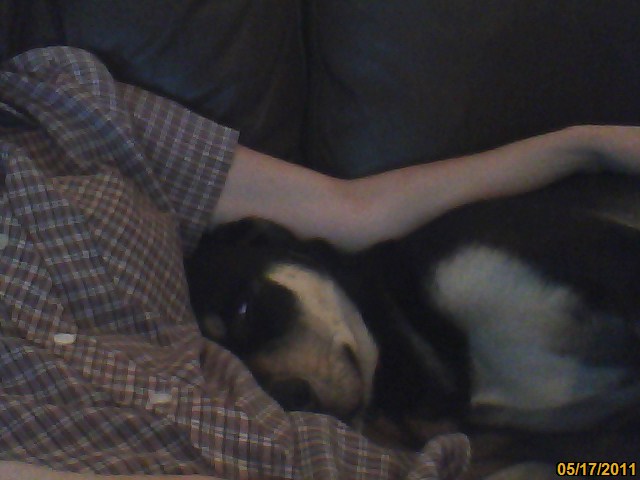
When I was recovering from chemo, Boomer was my reason to get outside and start walking. If it wasn’t for her, I would have stayed inside much more than I did. I’d get out of the house 45 minutes a day, or I’d take her to the dog park on the weekends. She kept me from becoming a complete shut-in during chemo and radiation.

Me and Boomer after my double mastectomy
After my double mastectomy, I was on FMLA leave for six weeks. Boomer kept me company while I slowly shuffled up and down my stairs and slept off my pain medication. We posed for selfies, we slept on the couch and we went to the dog park when I had to get out of the house.
I don’t know if I’ll ever have children and sometimes, I don’t know if I want to have any children. This might be the part where you think, “Oh great, she’s going to compare her dogs to children.” Nope, not in the slightest. Boomer and Mal are my beloved pets, and I adore them with everything I have. I’m going to take as good care of them as I can until death do us part. I love Mal, but Boomer is definitely special to me. Boomer is more than just a pet – she’s the creature that got me through two of the roughest years of my life. She was my lifeline during treatment.


She is why I fight the Pink Ribbon culture. She is why I throw away my bedazzled “survivor” sash and pink boa. She is the reason why I want every one I know to think before they pink. She is why I want to be a fearless friend for all those with metastatic breast cancer. I love being NED and thank God every day for that and good health. I want to be a part of the breast cancer discourse which sees us providing support to those with metastatic disease and abandoning awareness for the sake of awareness and the trivialization of a deadly disease.
My mother was more than a statistic. She was a daughter, a sister, a cousin, a friend, a wife, a mother, a devout Catholic, an aunt, a social worker, a student…. She had a great life, and metastatic breast cancer was what killed her, not who she was. I don’t remember my mother, but I’ll never stop wanting to make her proud.
Recently, a friend of mine sent me a message on Facebook, asking me why I hated Komen so much. I sent her a five-point, abridged version with my reasons, but I wanted to really write a well thought-out reason as to why I think Komen is a horrible organization.
Komen is allergic to reality
https://twitter.com/KomenKnox/status/440623262075453441
Really? Oh really? Breast cancer is the pink elephant in the room, and let’s not ignore it? Since when is breast cancer ever ignored? It’s not the pink elephant in the room. It’s the pink elephant on a rampage, mowing down innocents in the street. We have an entire month devoted to so-called breast cancer awareness. Every time I went into a retail store in the months of September and October, I was assaulted by crap with pink ribbons.


At least I can disinfect my hands after all this pink ribbon garbage.
Breast cancer isn’t being ignored. You know what’s being ignored and the real elephant in the pink room (see below for more on this reference): metastatic breast cancer, aka Stage 4 breast cancer, which leads me to….
Komen has ignored those living with metastatic breast cancer disease.
According to Peggy Orenstein’s April 25, 2013 article in The New York Times called “Our Feel Good War on Breast Cancer,” she wrote:
Last October, for the first time, Komen featured a woman with Stage 4 disease in its awareness-month ads, but the wording carefully emphasized the positive: “Although, today, she has tumors in her bones, her liver and her lungs, Bridget still has hope.” (Bridget died earlier this month.)

Komen has been around for decades, and it was only in 2012 that someone living with metastatic breast cancer was in any of its advertisements. I am very sorry that Bridget died at such a young age, and she was definitely entitled to her hope and mindset. But I hate that even when someone with Stage 4 is in a campaign, the wording is still positive and upbeat because heaven forbid, you get angry or upset at your diagnosis. Angry women and men with metastatic breast cancer need not apply.
An October 11, 2012 Today.com item actually interviewed those with metastatic breast cancer about “Pinktober.” (Side note: glad some members of the media are actually giving voice to those living with metastatic breast cancer.)
For Stage IV patient Kimala Clark, 47, of Fort Wayne, Ind., it feels like a betrayal to walk into a grocery store and be “bombarded with pink.”
“I can’t celebrate because I’m not a survivor,” said Clark, who was diagnosed in 2010 with an aggressive Stage III cancer that quickly advanced. “There’s not a cure.”
Isn’t that heartbreaking? Later in the article, it mentions how during the entire month of October, only one day is dedicated to metastatic breast cancer:
In addition to questionable product endorsements, late-stage patients protest what they believe are unfairly limited funds for metastatic breast cancer research and a cursory focus on the end stages of the disease.
In all of October, for instance, only Oct. 13 — Metastatic Breast Cancer Awareness Day — focuses on late-stage disease, Clark says.
“I really would have liked to see that be more than one day. I think it’s sad that there’s 31 days in October and we have one day,” she says.
Those living with and dying of metastatic breast cancer should be at the absolute forefront of the breast cancer discussion. No ifs, ands or buts. That’s it. Yeah, I get those who want to celebrate their survivorship. Go right ahead. While you’re celebrating, remember and response those who were diagnosed Stage 4. Your celebrations should never quiet those who are Stage 4.
One of the most gifted bloggers I have come across is Ann, who writes “Breast Cancer…. but doctor I hate pink?” I think everyone should be reading and following Ann. She wrote a gut-punching, to-the-point blog called “Pinktober from a Metastatic Point of View”:
Metastatic women? Almost nothing. I believe there are fewer than ten support groups for advanced cancer listed in the US. Despite our differing needs, we are lumped in with all breast cancer groups, and worse, we have, in droves, been turned away from early stage groups, pulled aside and whispered to by coordinators, saying “you will frighten the early stage women.” There are very few books for metastatic women as compared to the hundreds for early stage. Even online support groups end up with women fighting about whether early stage women should be allowed to post in the Stage IV sections. Many argue that they should be allowed there because they could have metastatic cancer any time, as if that means they understood what it is like now. There seems to be little available for our emotional needs.
We don’t fit in with our “pink sisters.” Our concerns are very different, yet we are expected to be just like them, after all, it’s breast cancer. Alone, we are left to deal with real issues of life and death.
Who has created this environment where those with metastatic breast cancer feel marginalized and told to go away? Susan G.-freaking-Komen.

Let me go back to the Pink Elephant now. Here’s the pink elephant ad again.

Hey, guess what, Komen’s corporate sponsor here – Kohl’s – they co-opted the campaign from Metavivor, a small charity which dedicates 100 percent of its money received to funding research. From Metavivor’s blog:
The Elephant in the Pink Room is not merely a clever slogan, it represents the core of our work and what we stand for. In our campaign, which originated in 2012, the pink room represents the primary breast cancer community which has more funding, recognition and attention than any other disease. Primary breast cancer is hardly a pink elephant – women cannot escape that breast cancer conversation. The real elephant is metastatic breast cancer, the dark side of breast cancer that no one wants to acknowledge or talk about. As our Elephant in the Pink Room campaign states: “In the ‘pink room’ of the breast cancer conversation there’s an elephant being ignored – we the 30% of patients with breast cancer who metastasize”.
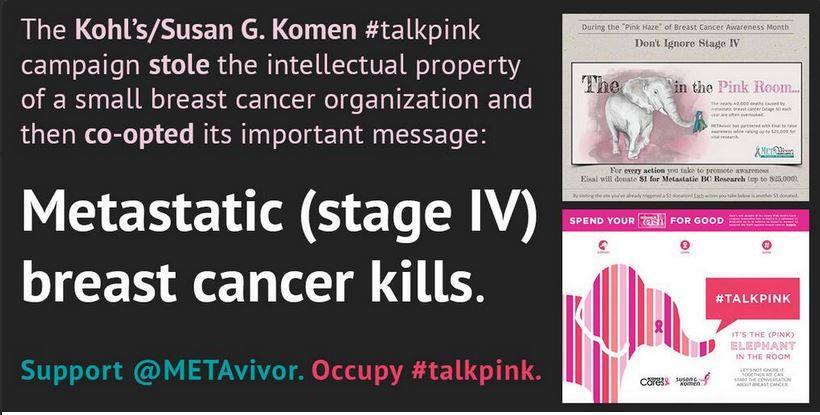
This graphic was made by Christina, whose sister Vanessa died of metastatic breast cancer in February 2014 at the age of 32.
If you’re on Twitter, please go and occupy Kohl’s and Komen’s hash tag #talkpink.
Komen sues smaller charities who use “for the cure.”
A June 1, 2011 Star Tribune article reported that Komen sent a cease and desist letter to a small non-profit which raised $30,000 to fight breast cancer.
Sue Prom helped organize the “Mush for a Cure” sled-dog race to raise money to fight breast cancer five years ago, a fundraiser that was humming along nicely until it received a letter from an attorney for the organization Susan G. Komen for the Cure.
Komen, best known for its pink ribbons, Mother’s Day runs and other mega-fundraisers for breast cancer research, asked Prom to stop using the phrase “for a cure” and to halt its request for a Mush for a Cure trademark.
“It was like, ‘You’ve got to be kidding,'” said Prom, whose all-volunteer fundraiser outside Grand Marais, Minn., raised about $30,000 last year.
Do you think individuals who donated to Susan G. Komen foundation knew their money would be used to sue other charities who want to raise money like Prom was doing? Here’s the kicker? Once national news shone a spotlight on Komen’s bullshit move, they backed off.
Komen dropped its objection to the dog-sledding fundraiser earlier this year, Prom said, shortly after NBC News highlighted the plight of Mush for a Cure and a New York group called Kites for a Cure. In April, a certificate arrived in her mailbox giving her the trademark for “Mush for a Cure.”
I doubt Komen changed its mind out of the goodness of its heart. Oh no. Bad publicity would affect its donations and bottom dollar, and of course that cannot happen. An August 5, 2010 article in The Wall Street Journal stated that Komen went after a small charity dedicated to raise money to fight lung cancer.
Last year, [Mary Ann] Tighe’s Uniting Against Lung Cancer got a letter from Komen requesting it change the name of the charity’s “Kites for a Cure” fund-raiser, a beach event featuring hand-decorated kites, to “Kites for a Cause,” or another name. Komen later warned her against any use of pink in conjunction with “cure.”
Ms. Tighe dug in her heels. She refused to change her group’s name or declare pink off limits even though, she says, her group hadn’t used the color. “We don’t want to be the color police,” says Ms. Tighe, who didn’t feel she was poaching Komen’s slogan.
But as the legal battle ensued, her group agreed to a truce where it would limit the use of the event name to lung-cancer activities, and it promised to stay away from the pink ribbons made popular by Komen. [Jonathan] Blum [Komen’s legal counsel] characterized the negotiations as “cordial and productive.”
Seriously.
Komen’s CEO and founder, Nancy Brinker, has made a lot of money
According to Komen’s website:
Nancy G. Brinker promised her dying sister, Susan G. Komen, she would do everything in her power to end breast cancer forever.
I wonder if that promise included Ms. Brinker getting paid. I mean, girlfriend got seriously paid. Dolla dolla bill, y’all. A May 3, 2013 Dallas News article announced her payday:
The nonprofit’s latest 990 IRS filing shows that Brinker, founder and CEO, made $684,717 in fiscal 2012, a 64 percent jump from her $417,000 salary from April 2010 to March 2011.
The filing says Brinker devoted 55 hours to the cause each week, giving her an hourly rate of $239.40, roughly twice the salary of Komen’s chief financial officer Mark Nadolny or former president Liz Thompson, who left the organization in as a result of the brouhaha.
News outlets compared her salary to others in a similar position.
Ken Berger, president and CEO of Charity Navigator, which evaluates and rates charities, called Brinker’s salary “extremely high.”
“This pay package is way outside the norm,” he said. “It’s about a quarter of a million dollars more than what we see for charities of this size. … This is more than the head of the Red Cross is making for an organization that is one-tenth the size of the Red Cross.”
The American Red Cross had revenue of about $3.4 billion, while Komen’s was about $340 million last year. Red Cross CEO Gail McGovern makes $500,000, according to the most recent financial documents available for the charity.
Way to honor your sister there, Nance.
Lastly…
Komen has yet to embrace this thing called science.
Komen has sold the myth that mammograms save lives and the world needs more mammograms and mammograms for everyone! Get one soon or you’re going to die…. wait, what?

This is an actual ad from Komen, and you know what’s wrong with it? First, the five -year survival statistic for breast cancer when caught early is not 98 percent. That’s a five-year survival statistic for Stage 0 or DCIS (aka pre-breast cancer). Technically, my breast cancer was caught early – Stage 1. However, since my cancer was invasive, I still have about a 25 to 30 percent of developing metastatic breast cancer. Catching breast cancer early is not a 100 percent guarantee one will never have to deal with metastatic breast cancer. Unfortunately, 30 percent of those who had early stage breast cancer go on to develop metastatic breast cancer.
Rachel Cheetham Moro, the blogger behind Cancer Culture Chronicles and who died of metastatic breast cancer, had this to say about Komen and its campaign:
How dare Komen so FALSELY suggest that a screening mammogram is all it takes to avoid metastatic breast cancer? How dare Komen so CRUELLY suggest that “not getting screened for breast cancer in time” would be THE reason and the FAULT of the person with metastatic disease who misses out on all the experiences and joyous events of a long and healthy life that so many others take for granted? How dare you, Komen? How dare you?
Here is a great analysis, published on October 3, 2012, on the blog Pink Ribbon Blues and written by Christie Aschwanden:
Komen isn’t wrong to encourage women to consider mammography. But they’re dead wrong to imply that “the key to surviving breast cancer” is “you” and the difference between a 98% survival rate and a 23% one is vigilance on the part of the victim. This message flies in the face of basic cancer biology.
Between 2004 to 2009, Komen allocated 47 percent of it $1.54 billion toward education and screening. Much of its education messaging promotes the same false narrative as its ads, which means they are not only not furthering the search for a cure, they are harming the cause. By implying that the solution to breast cancer is screening, Komen distracts attention from the real problem, which is that way too many women (and men) are still dying of breast cancer, and screening is not saving them. We still can’t prevent breast cancer, because we don’t know what causes it.
To summarize, I’m not against Komen because of one thing or two things. It’s more like a handful of things that have led me to know with all my heart and conviction that Susan G. Komen is the problem, not the solution. I believe Komen began with good intentions but has morphed into this pink ribbon behemoth. Women (and men) are dying from this disease, and we need to refocus (fuck awareness – WHO ISN’T AWARE OF BREAST CANCER?). They deserve better, much much better.
Whenever I talk about why research for metastatic breast cancer is so important for me, I typically post this picture, which was obviously taken when I was just a wee one.

When I have mentioned that my mom died of breast cancer and then I post that picture, it recently dawned on me: “Huh, I wonder if anyone seeing this picture thinks that she died when I was a baby, not when I was in the second grade.” That’s what got me wondering and subsequently asking my dad, “Hey, are there any pictures of just me and mom?”
My dad could only find two pictures, and it wasn’t any posed pictures of mother and daughter, it was two stolen moments that my father, an amateur photographer, caught. He tried to explain why and how this happened, “Well, she didn’t like to have her picture taken.” For the first time in a very long time, I felt really mad at my mother.
Someone reading this might think, “Well, the 80s were different. It’s not like nowadays where everyone has a camera phone and it’s selfies 24-7.” My dad has been an amateur photographer since his 20s, and he usually had his camera nearby. My dad is the guy with the camera. He sure as heck brought it to family events. My mother dodged the camera. She scowled and protested at my dad when he tried to take more pictures. My mother was well known for her camera avoidance.
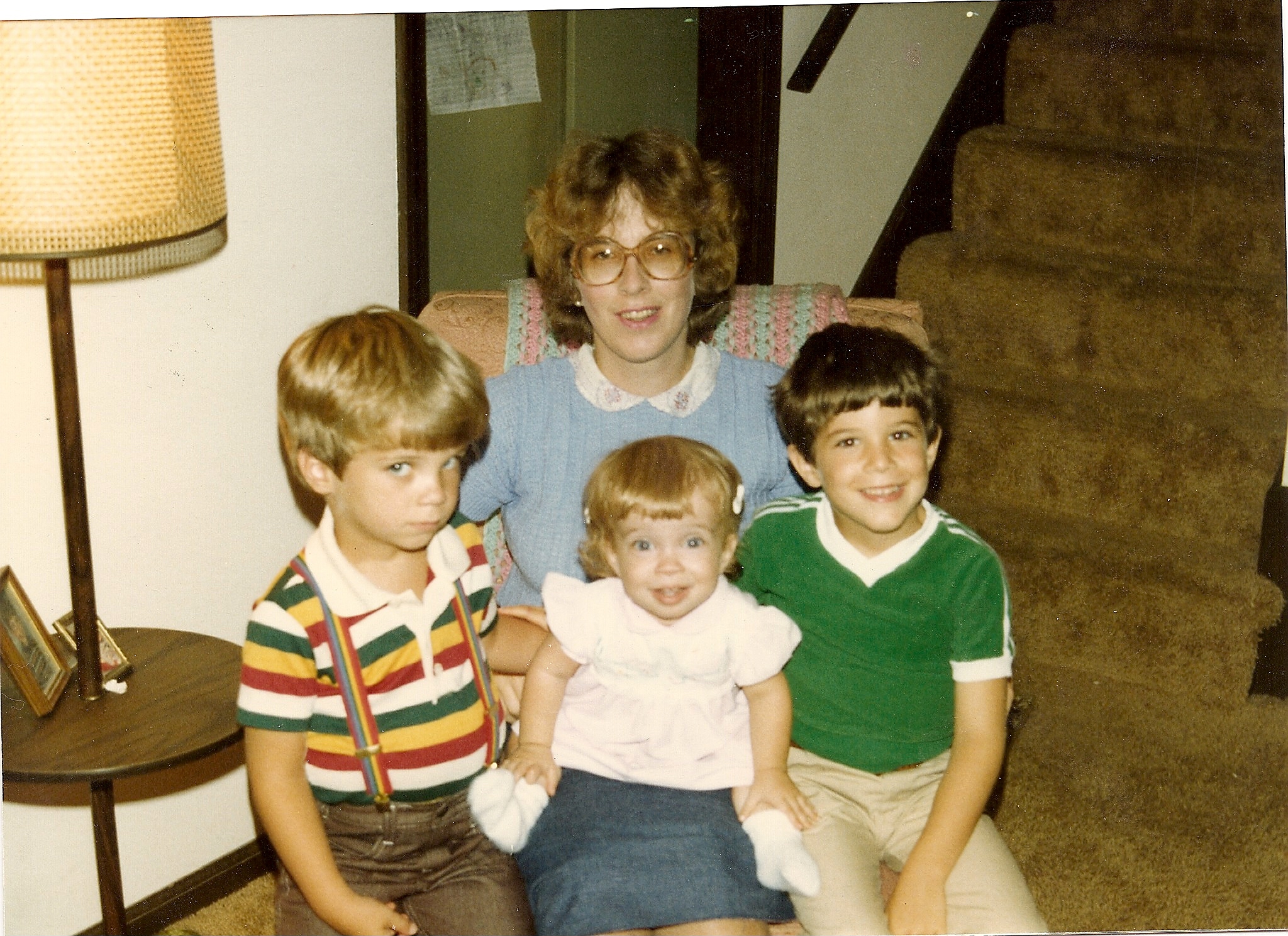
Ever the peace keeper, my dad’s response when I expressed disappointment via email regarding the lack of pictures of mother and daughter: “Memories can be sharper than images.” She died when I was 7 years old. I do not have memories of her – they are more like snippets. Plus, the snippets I have of my mother are from when she was sick from cancer treatment, not as the mother she probably wished I remembered her as. Oxygen tubing, hospital visits, wigs.
As a 33 year old woman, the thought of being mad at my mother is so foreign to me. Like, real, justified adult anger at a very deceased woman. I feel pissed at her for not getting over her hatred of being photographed and just sucked it up. I wished she would have said to my dad, “Hey, grab the camera. Take a picture of Lara and me.” Nope, she didn’t do that. She ducked and dodged my dad’s camera like he was a landmine she didn’t want to step on.
In her defense, she was sick for a long period of my life from ages 2 to 7, but I would have still cherished a picture of my mom hugging me, showing some sort of maternal affectionate for her only daughter. Some tangible proof that she was here and she loved her daughter, a daughter she worried (according to a friend of hers) would also have breast cancer. I wouldn’t have cared in the slightest if I had pictures of my mother when she was sick if I was in the picture, too. Her illness was a part of our lives, but I imagine that’s not something she wanted my dad to capture.
When she disappeared from the pictures, she disappeared from the events that took place. One of the snippets I remember from a family vacation we took the summer before she died took place at a go-kart place in Panama City Beach, Fla. My brothers were each driving their own go-kart, and I was in a go-kart with my dad (since seven years old aren’t allowed to drive those things). My mother stood off to the side, watching us and hanging out by the railing. She wasn’t participating, just watching. When I think about that memory, it makes me sad because I have wondered if she was just disappearing right then and there. My mother disappeared from my memory, and now she’s been this abstract figure in my life, as tangible as a dream.
My plea to parents, and this goes to anyone really, don’t disappear from the pictures. Who cares if you think your hair is frizzy or you have a “weird” smile or whatever hangup or lie that we tell ourselves, and don’t want to be in the pictures? When you have children, forget all that and just get into that picture. Smile. If you are the one usually taking the picture, because as the photographer at events I know how easy that can happen, then hand the camera off to someone! Strangers are usually cool if you ask them, “Hey, can you take a picture?”
I’m not 100 percent sure why my mother avoided having pictures taken while she was sick. Maybe given her hatred of the camera before cancer just meant that the hatred multiplied by 100 after her diagnosis? Maybe she thought if she didn’t let my dad take pictures of her bald or with a horrible wig on or other hospital-related scenarios, that we wouldn’t have to remember a horrible time in our lives. Guess what, we still do. Whatever it was, she did a disservice to me, her youngest child. I was robbed of my mother, and then my mother robbed me of the ability to have a precious keepsake of just her and me.
 Get Up Swinging