Thyroid Cancer during Breast Cancer

“Ms. Huffman, have you noticed a fullness in your neck?”

This was the question I heard from my primary care physician, who I had gone to see for a mammogram referral, which would eventually lead to my breast cancer diagnosis.

“Yes, but I had a radioactive treatment several years ago to treat a goiter on my thyroid.  I had thought the treatment took care of that.”  Women on both sides of my family have had problems with their thyroid; my mom had her thyroid removed when she was 16, one of her cousins had thyroid cancer, and one of my aunts had thyroid cancer.

“Hmmm, I believe that may not be the case.  Regardless, you need to see a specialist and have this checked out further.”

For a period of almost two months prior to my breast diagnosis, I had numerous appointments for scans, biopsies and specialist consultations for both my thyroid and breasts.  My bosses, bless their hearts, let me have flexible hours at work to make up for the plethora of appointments.   If they hadn’t been so accommodating and helpful during that initial period, I surely would have lost my mind.

I was diagnosed with early stage breast cancer in late September 2010.   Several weeks afterwards, I met up with an endocrinologist to discuss the results of my thyroid biopsy.  He informed me that there was a significant chance I had thyroid cancer, too, and I needed to have my thyroid removed.

Being told that you may have cancer while you already have cancer, it’s surreal, to say the least.  My inner monologue was basically: “Hahahahahahahahahahahaha.”

Since the breast cancer was considered the biggest threat, treatment for those particular rogue cells took priority.  However, a month after I was done with chemotherapy, it was time for the thyroid to be exorcised . . . I mean, removed.

After the full thyroidectomy, I was a sight to be seen: bald, greyish pallor and sporting a giant neck wound.  The first night after my surgery, I fainted in the bathroom and woke up surrounded by unfamiliar nurses and doctors all saying my name really loudly.   Apparently, as I was falling down, I had hit my head and the nurse’s aide (who I had insisted that she stay outside the bathroom because “I’m an adult and don’t need help in the bathroom”) caught me as I crumpled to the floor.

It was a “fun” night after that, and I was sprung from the hospital on my 31st birthday.  Happy birthday to me!

It wasn’t easy trying to get my thyroid hormones leveled while dealing with radiation for breast cancer.  I felt tired in ways I didn’t think were possible.   Since I no longer had a thyroid, I take Synthryoid every day and will do so for the rest of my life.  I never wanted to be on a medication for the rest of my life before my thyroidectomy, but now that I am, I don’t care in the absolute slightest.  Given how much trouble my thyroid caused me in my 20s (i.e., untreated hyperthyroidism for years), my only regret is that I didn’t have it removed sooner.  When your thyroid is off, everything about you and how you feel is off.

Symptoms of hyperthyroidism (which I checked off most of them):

  • Difficulty concentrating
  • Fatigue
  • Frequent bowel movements
  • Goiter (visibly enlarged thyroid gland) or thyroid nodules
  • Hand tremor
  • Heat intolerance
  • Increased appetite
  • Increased sweating
  • Irregular menstrual periods in women
  • Nervousness
  • Restlessness
  • Sleep problems
  • Weight loss (or weight gain, in some cases)

Hypothyroidism (defined as a condition in which the thyroid gland does not make enough thyroid hormone) symptoms:

Early symptoms:

  • Hard stools or constipation
  • Increased sensitivity to cold temperature
  • Fatigue or feeling slowed down
  • Heavier and irregular menstrual periods
  • Joint or muscle pain
  • Paleness or dry skin
  • Sadness or depression
  • Thin, brittle hair or fingernails
  • Weakness
  • Weight gain

Late symptoms, if untreated:

  • Decreased taste and smell
  • Hoarseness
  • Puffy face, hands, and feet
  • Slow speech
  • Thickening of the skin
  • Thinning of eyebrows

I want to emphasize that if you think you could possibly be dealing with either hyperthyroidism or hypothyroidism, consult a doctor, who can order simple blood tests.   I felt off for so many years, and I had no idea it was because of an overactive thyroid.  I suffered from panic attacks, insomnia and a ravenous appetite that never let up.  Once a doctor figured out what was wrong and got my levels regulated, I felt normal again.

Dealing with thyroid cancer at the same time as breast cancer wasn’t easy or fun, but I’m beyond relieved that my thyroid is gone.  I admit that I miss my old chest often, but my thyroid?  Nope.  I hope it went straight to hell, which is where I’m sure it came from.

Is cancer the “best death”?

When the cancer community read the blog “Cancer is the best death,” written by Richard Smith, a doctor, it’s not surprising that it was met with a negative response.

So death from cancer is the best, the closest to the death that [Luis] Buñuel wanted and had. You can say goodbye, reflect on your life, leave last messages, perhaps visit special places for a last time, listen to favourite pieces of music, read loved poems, and prepare, according to your beliefs, to meet your maker or enjoy eternal oblivion.

This is, I recognise, a romantic view of dying, but it is achievable with love, morphine, and whisky.

When I first read that, my jaw dropped and major eye rolling commenced.  Did he describe dying of cancer, or was he paraphrasing a horribly cliched Hollywood movie he just watched?  Didn’t Nicolas Cage star in a movie of someone slowly killing himself with alcohol?

What I can remember about my mother’s death from breast cancer certainly does not reflect Dr. Smith’s romantic view of dying.  My mother spent a lot of time in treatment, or at church or with her family, trying to get in as much time in with her young children that she could.  She didn’t go on some soul-searching journey or adventure to cross off all those items on her bucket list.  She was in treatment for metastatic breast cancer and at the end, she died in a hospital, surrounded by her loved ones.  My mom only lived six months after she was diagnosed with mets.  She didn’t have time to visit any special places, unless you count doctors’ office and hospitals as special places.

Janet Freeman-Daily, a metastatic lung cancer patient who writes at Gray Connections, responded (please read the entire blog):

The reality is that death from cancer often does not conform to Smith’s vision.  Death by cancer happens when tumors cut off your air supply, compress your heart so it can’t beat properly, block your gut so you can’t eat, cause organ failure, erode your bones, press on nerves, or destroy bits of your brain so you can’t control your body or think properly.  Sound painful?  Without pain medication – sometimes even WITH morphine and whisky – it is.

As far as I know, Dr. Smith does not have metastatic cancer.  Ms. Freeman-Daily does, and she writes, unsurprisingly, a realistic view  and description of cancer.  Ms. Freeman-Daily also points out:

Among the lung cancer patients I’ve come to know online through their own posts or those of their caregivers, death can claim patients before they have established financial security for their family, raised their children, finished college — or even had time to recognize that they are dying. Many linger after they’ve lost the ability to do what they love, communicate, or think clearly. Most will eventually find themselves dependent on others for their basic needs while still aware of the emotional and financial stresses their illness imposes on their loved ones.

Some diagnosed with Stage 4 cancer may die within weeks or months of their diagnosis.  Others may live with metastatic disease for years and die after all lines of defense have failed.   I followed the blog of Vanessa T., who recently died of Stage 4 breast cancer.  Her family loved her so very much, and watching her slip away because of the mets to her brain was horrible.  How could anyone see anything romantic or ideal about her passing at such a young age?

Marie Ennis O’Connor also wrote a response to Dr. Smith’s blog:

Not everyone who dies of cancer has this peaceful idealised death. My own mother’s death from brain cancer was  far removed from romantic.  Both men write of a dignified and peaceful death, along the lines of our work here is done on earth – but what of the young mother with metastatic cancer who desperately wants to be there for her children growing up? Is love, morphine and whisky enough to ease her pain?

The most offensive, mind-boggling part of Dr. Smith’s blog post was this:

But stay away from overambitious oncologists, and let’s stop wasting billions trying to cure cancer, potentially leaving us to die a much more horrible death.

I will contend that there are probably cancer patients out there who continue with various treatments, only to make their remaining weeks or months excruciating and painful.  They might choose to do so because they feel pressure from their families to continue on, or they are relying on possible false hope given by medical professionals (possibly the “overambitious oncologists” Dr. Smith is referring to?).  You know what, though?   If a patient does make that choice and they are of sound mind, then their decision should be respected, not pitied or judged.   To take away someone’s hope, no matter how unrealistic it may be, would be cruel.  Perhaps an oncologist may be overambitious, but what if the patient wantthat type of attitude and approach?

Nobody knows what they will do when faced with the hard decisions that terminal cancer patients deal with during their treatments.   As much as I loathe the word, I will use it here: dying is very much an individual journey.  I pray that those facing these decisions aren’t pressured to keep going on if they want to just live out their remaining days without debilitating treatments.  When terminal cancer patients decide it’s time to stop, those decisions should also be respected.   People should be allowed to die with dignity.  These broad statements, like the one Dr. Smith makes, implies that terminal patients should just check items off their bucket list and die already.

I will never ever agree with the statement that we should stop “wasting billions trying to cure cancer.”  Nope.  Cancer research has saved lives and will continue to save lives.  The money being spent and used on cancer research is priceless to those with metastatic disease  who don’t have the gift of time or people like me, in remission, who pray to God that my disease doesn’t come back.

But it’s not like I have a choice in the matter.  Cancer doesn’t work that way.

My New Year’s Resolution

(I know, I know.  I am a couple of days early, but I wanted to get these thoughts out before my schedule gets crazy busy again.)

1.) Less social media.  This past week, I actually deleted around 300 people from my friends’ list, and I took the Facebook app off my phone.  For a long time, I began to feel social anxiety regarding my Facebook account and my friends’ list.  “Oh, these friends had a party, and I wasn’t invited.  I am the worst!”  “[This person] just unfriended me.  Why?  Did I say something?”  The whole point of Facebook is stay connected, so why did I keep feeling such negativity?   It’s not worth it.  I wanted to get rid of my account altogether, but I would lose my Get Up Swinging Facebook page, along with my photography Facebook page.

I really want to focus on quality of friendships, not quantity.  I found myself becoming complacent in my relationships because of the social media connection with them.  What happened to emails, texts, phone calls or actually getting together and having dinner?   I have a great group of friends, and I want to have authentic relationships with the people who matter the world to me.  I gave too much of my time and energy to people who in the grand scheme of things, aren’t that important to me.

2.) READ MORE BOOKS.  My 2014 Reading Challenge over at Goodreads was 25 books.  I’ve read 13.  That’s just unacceptable.   Granted, I probably read 4 or 5 books in 2013, which is completely horrendous.  I’m better than that.  2015 will be the year I get my bookworm on’ – this I vow.

Reading-quotes-3

3.) Write more, increase breast cancer advocacy.  I have so many ideas I want to do for Get Up Swinging, and I should take advantage of the fact that I can cross-post to the Huffington Post.  Metastatic breast cancer still and always needs more, and I can always find ways to help and increase ways for those who need it the most.

4.) Run three half marathons, run a 15 mile race, run a Ragnar relay and run the Rachel Carson Half challenge in June.  I’m not going to disclose my desired time for my next half because who knows if I’ll even come close to that.  The beauty of running when you don’t accomplish the time you wanted: there’s always the next race.  Get up and try again.

5.) Dedicate as much time and energy as I can into my photography.  Shoot more, learn more, create more.  When wedding season rolls around in 2015, I hope my mentor will keep having me around and we can inspire clients to HIRE me as a second photographer.

Like I do every year, I hope and pray that this year will be one of great, positive changes.  Since becoming a runner, I believe in my heart that I can make these changes happen (two years ago, I never would have believed I could have run 5 miles, nonetheless 13.1).

I don’t want to dwell on the negative because that’s how you get stuck, and I’m tired of feeling stuck.  All I want to do is move forward and upward.

Backbone

Backstage at a dance recital when I was in the fifth grade, two girls took a toy away from me and decided to play keep away.  They tossed the toy back and forth with me in the middle yelling, “GIVE IT BACK.”  When my protests didn’t yield the result I wanted, I stomped on one of the girls’ foot and shrieked, “I said… GIVE IT BACK.”   Since I stomped on her foot with my high-heeled tap shoe, she quickly handed over my toy, and I walked away in victory.  I never did like the keep away game.

Two years later, in a seventh grade history class, Austin, the kid who sat behind me, decided to be a dick (or a typical 12- to 13-year old) and pull my desk away from me when I sat down.  As expected, I fell down, and everybody in the class laughed at me.  I got up furious.  Austin laughed the hardest, and I’m pretty sure my face turned red in rage and embarrassment.  I picked up the binder from his desk and threw it across the classroom.  Well, Austin’s binder was full of nothing but loose leaf paper, and all the papers went flying every which way.  The history teacher, who saw and heard everything, stood up from his desk and ordered Austin to go outside (after he collected all his paper, of course).  He protested and said, “Why isn’t Lara going outside?  She threw my binder!”  The teacher replied: “You started it.”   I felt vindicated as I watched him sulk outside the classroom.

As I went through middle school and high school, I slowly lost that fight I had in me.  In middle school, I was openly ridiculed and laughed at by my peers.  They would point and laugh at me, and call me all sorts of names, with an emphasis on how ugly they thought I was.  However, my story is certainly not a unique story.  Puberty is a bitch, and anyone who comes out of adolescence unscathed is lucky, lying or the one who did the name-calling.

Routinely hearing how others think you are the ugliest thing they had ever seen, does take a toll on you.  It’s like every time someone decided to put me down to make themselves feel better, they took a piece of my self-esteem, backbone from me.   I learned to keep my head down and to stare at the floor because sometimes making eye contact with them, just fueled the nastiness in their heart.  I internalized these insults, these unwanted names (again, not atypical for young teenage girls).

I am hideous.

My hair is a mess.

Ugh, my teeth are messed up.

During college, I slowly got some of that fight back in me.  Usually, though, these instances were just examples of me being young, stupid and drunk, aka a typical college student, but these moments of backbone were motivated by my desire to stick up for a friend.  Once at a bar, I totally lost it when this random guy was saying obscene, offensive things to my roommate and best friend.  The dude was just being nasty, and he was not taking the hint from my friend that she thought he was nasty.  Me, being young, stupid and drunk, told him off, and our fight quickly got ugly.  After I called him out for being a nasty creep, he of course had to call me a bitch and then an ugly bitch (because the worst insult a woman can be called is ugly – yawn – or a bitch).   This guy and I had to be separated after I got in his face.

A year or so later, I tried to stick up for this friend of a friend who was being dense and not noticing or caring that he was invading another guy’s space.  I said, “Hey, it’s cool,” to the guy who was losing his temper and threatening the dense friend of a friend.  This guy growled at me, “Bitch, shut the fuck up.  If you say another word, I will beat the shit out of you.”  I believed his threat and became paralyzed in fear.   The guy who threatened me was escorted out of the bar after my friend got me to tell her why I was shaking in fear, and she told the bouncer.

As I got older, once again, I lost that fight, my backbone just fading away.  I never stuck up for myself against certain individuals, who would treat me like a doormat.  Now and then, I would argue or walk away instead of letting someone boss me around or treat me poorly.  I didn’t fight.

I compromised.  I played nice, even when I was mad or insulted, and bit my tongue, even when someone said something unkind.  But if you keep doing that, as I learned, you let others think it’s okay to talk or act a certain way around you.  By playing nice, these negative people learned it was okay to treat me with little to no respect.  I mean, why not?  It’s not like I would ever say anything.

Then breast cancer happened.

After five surgeries, seven weeks of radiation, four months of chemotherapy, one anaphylactic reaction (and a partridge in a pear tree), I became a shell of myself.  After I emerged from the wreckage that is cancer treatment, I had to rebuild myself.  My priorities and perspectives changed, and much to my surprise, my fight came back.   I guess, when you deal with insurance company bullshit, plus all the stress that comes with managing your treatment, appointments, job (if applicable) and personal relationships, you have to have some backbone.   My fight definitely came through whenever I had to make repeated calls to Aetna and fight them over their most recent bullshit claim denial.   My backbone reappeared when I let friendships that should have died years ago just fall by the wayside.

In recent months, I have stuck up for myself in ways I had never done in my adolescence or early adulthood.   When I felt hurt and offended by a loved one, I told that person that they hurt me and why they hurt me.  Although I received a negative response, I felt better because I expressed myself and my feelings are valid, even if they make someone mad.   When someone confronted me for what I wrote (and to be fair, what I wrote was passive aggressive and uncalled for), I stood up for myself and didn’t back down from what turned out to be a nasty fight.

Don’t get me wrong – I’m not going turn into some Bravo Reality Tv Housewife and start flipping tables and screaming obscenities.  I’m certainly not going to be physically fighting anyone (yikes!) or creating Youtube videos telling my “haters” to suck it.   (Waaat.)   It means having professional goals and aspirations and fighting for them.  It means I’m not going to care about how many friends I have – just about the quality.   It means I want to have authentic relationships with my loved ones, which means expressing my feelings instead of swallowing them.

It means I’m going to stand up for myself, no matter what – because I’m worth fighting for.  Since I’ve already ran two half marathons and additional long races, I know I have some fight in me.

Diem Brown

The recent death of Diem Brown, and the headlines regarding her death from cancer made me really think about the over-usage of the battle and fighter metaphors when we discuss someone’s death from cancer.   If you do a google news search for Diem’s name, then pretty much all the headlines talk about her losing her fight or battle.

Anyone who even just casually followed Diem’s story knew that she had a positive attitude and a strong will to live.  She dealt with cancer since the age of 23 until her death at 32, and she became an advocate for those with cancer.  She blogged about her experiences, and she created the website MedGift.   I don’t want to focus solely on the death of Diem, especially in light of the fact that she used the warrior and fighter language, and one could assume that she would approve of the headlines about her death.

However, if you look up news stories regarding the death of high-profile figures who died of cancer, you will come across this language: Elizabeth Edwards, Adam Yauch, Roger Ebert, to name a few.  I also hope I don’t come off as critical of anyone who draws strength from using the fighting and warrior language to describe what they are going through.  Everyone is entitled to use whatever language they want to describe their own experiences, and I really don’t want to come off as the Word Police.  My point of contention is the use of this language when someone dies of cancer.

When we use the language that someone “lost a long battle/fight” with cancer, it suggests that someone in remission from cancer must have done something more than the one who died.  Someone who dies of cancer did not lose or give up or somehow lost any will to keep on living.

Michael Wosnick wrote about the battle metaphor:

It’s not the battle part that bothers me – it is the losing part. For those who ultimately die from a cancer, the idea that they have lost a battle implies to me that if they had just done something else differently then maybe they might have won [emphasis mine]. The use of the word, “lose” is like a zero-sum game to me: if someone or something loses then that means that someone or something else wins. You can’t have a loser if you don’t have winner. We should not so easily give cancer that kind of power over us.

A November 3, 2014 Independent item discussed the use of the battle metaphor in respect to those at the end of life.   The article discussed the findings of a study conducted by Elena Semino, a professor of linguistics and verbal art, who “analyzed 1.5 million words of discussion, representing the views of around 200 people closely involved with cancer care.”

Professor Semino remarked, “The battle metaphor applied at the end of life clearly can have harmful consequences for some people who end up feeling responsible for the fact that their illness cannot be treated.”  She also commented: “The metaphor somehow needs to account for the fact that you can live well with cancer.  There has to be another way to talk about someone who has died of cancer.”

Heather Cleland wrote in an August 16, 2011 piece in Walrus Magazine:

The language around cancer — of “battles” fought, won, lost, and succumbed to — fails to consider the sheer chance of it all [emphasis mine]. Sure there are cancers that we bring upon ourselves, but most are a result of the tiniest bits of bodies going rogue for reasons we’ve yet to understand. To speak of lost battles as though the warrior didn’t want victory badly enough projects our proclivity to control outcomes onto something that cannot be controlled. It’s futile, and it does a great disservice to people like Jack and Rachel who “fought” as hard as I did.

I don’t view the fact that I’m currently NED for breast cancer as a reflection of anything I did.   I cringe, and typically correct, when someone remarks about how I “beat” cancer.  I haven’t beat cancer, won or kicked its ass.  Until I die of something else, we don’t know if cancer is done with me.  I am in remission from cancer, or I’m NED.  I feel incredibly uncomfortable at any phrasing or hyperbole about what happened to me that paints me in some warrior, extreme fighter.  I was often tired, sad and scared, all of which are normal and to be expected.  I didn’t fight harder than someone else with the same diagnosis as me and who went on to have a recurrence.

Cancer is a complex, intelligent and dangerous disease, and we have given way too much credit to someone’s mindset for a positive outcome.  If a fighting spirit and positive attitude cured cancer, I’m pretty sure that Diem Brown would be alive and healthy.  Everyone also could probably name five people they’ve known who died of cancer who had a positive and fighting spirit, too.  Cancer does not care about that.

When I read the obituary for my #bcsm friend, Barb, who died of metastatic breast cancer, the last sentence made me smile, despite feeling very sad about her death:

Barb did not lose her battle with cancer; she lived graciously and courageously with it until the very end.

1 in 8

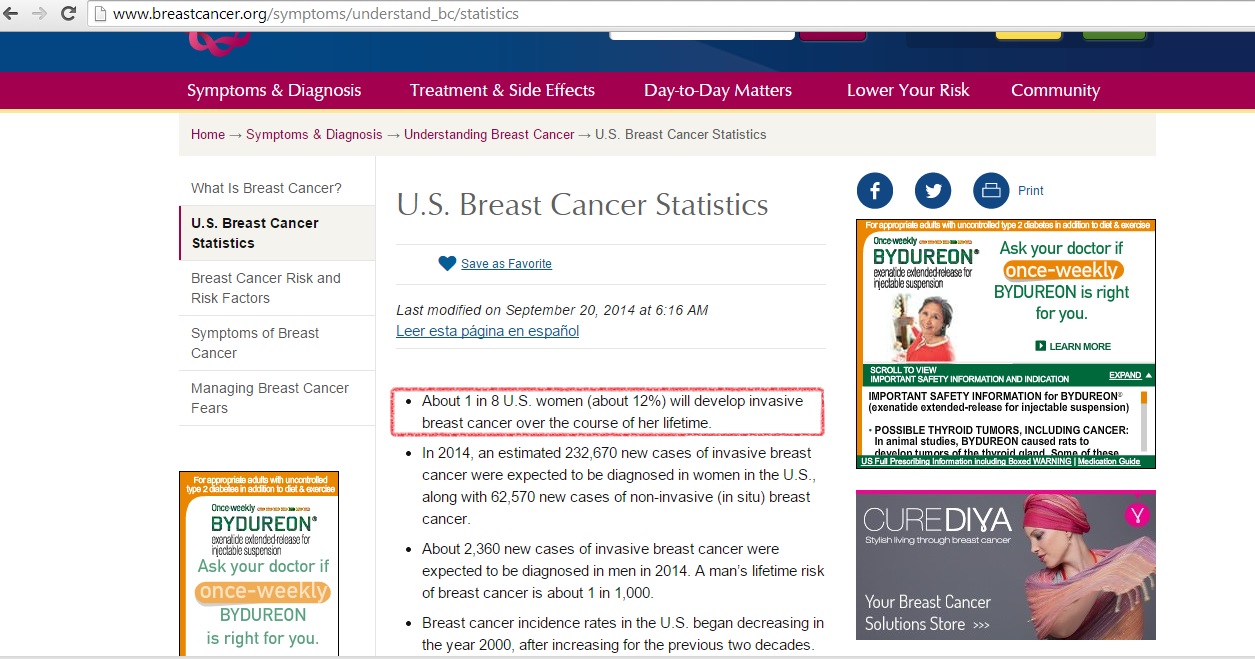
During this year’s Pinktober, did you happen to come across the “1 in 8 women will develop breast cancer in their lifetime” statistic?  Here are three screen caps with this statistic:

1in8-breastcancer.org

Now from the American Cancer Society’s website:

1in8-cancer.org

A Komen affiliate website:

 1in8

I actually learned recently that this 1 in 8 statistic is actually a teensy bit misleading.   Lifetime risk isn’t the same of your actual risk based on your age.  You know what blows my mind?  I found actual scientific information explaining this statistic on Susan G. Komen’s website (I know, knock me over with a feather):

Women in the U.S. have a “1 in 8” (or about 12 percent) lifetime risk of getting breast cancer [4-5]. This means that for every eight women in the U.S. who live to be age 85, one will be diagnosed with breast cancer during her lifetime.

Absolute Risk Komen

Source: Komen

So next time you come across the “1 in 8 women will develop breast cancer in her lifetime,” keep in mind the second part of that statement: “who live to the age of 85.”

I don’t know why charities and organizations use that statistic so much and with little explanation.  Maybe they want to scare people into thinking breast cancer is going to happen to everyone or maybe they don’t really understand the lifetime risk vs. absolute risk?

My friend AnneMarie, over at Chemobrainfog, wrote:

One in eight is a good springboard for a fundraising campaign.  It makes for a great way to terrorize those who do not understand that the number applies across your entire lifetime and it increases with age.  As you are seated around your table with eight family members of different generations or eight close friends, don’t try to figure out who, unless you also incorporate WHEN into the equation.

There are certain factors that increase your risk of developing breast cancer, and I fell in several of those categories: family history, dense breast tissue, certain benign (not cancer) breast problems and not having children (and related to that, not breastfeeding).  No doubt that these factors definitely increased my risk more than the 0.4 percent figure stated above.    Plus, now that I’ve had breast cancer, I’m also at an increased risk for developing breast cancer again.  Since treatment ended, I have made changes to my lifestyle, such as running and not drinking alcohol, among others, to minimize my risk because I never ever want to go through that again.

Cancer can often feel like a numbers game, although many doctors and specialists in the field will emphasize that you are an individual, not a stat.  When you fall on the bad side of these statistics, these numbers almost seem cruel.  I had less than one percent chance of going into anaphylaxis during chemo, yet that happened to me.  Cancer is definitely not something I ever wanted to be unique at.

I truly believe it’s important for us to know our risks and what we can do to minimize our risks for developing breast cancer.   First, we need to fight through the Pink Ribbon rhetoric seemingly designed to scare the general public with statistics without little or no context.

Guest Post from “Hazel Flatchest”

Here is a guest post from a woman who reached out to me.  Obviously her name is not Hazel Flatchest, but she wanted to remain anonymous. 

————————————————————————————————————————————————–

Breast cancer, you say?  Well, it is October…. That month when you walk into the grocery store and it looks like someone vomited Pepto Bismol all over the aisles.  So of course we want to talk all about breast cancer and awareness (gag!) and mammograms this month. Screw that.  Cancer is soooooo 2010.  Let’s talk about NOW.

The mastectomy scars have healed.  The port was removed.  The hair has grown back.  Everything should be back to normal, right? WRONG. WRONG. WRONG.  I don’t even know what “normal” is anymore.

But for the sake of argument, here’s my new “normal”:  I haven’t held down a full-time job for more than 3 months in over 4 years.  I cry several times a day.  Not out of sadness or depression (although I’ve experienced my fair share of both of those in the past four years…), but mostly out of sheer frustration.  I often feel as if I have lost my mind.  It is shrouded in a haze of chemo fog that has affected my ability to solve even the simplest of math problems or puzzles.  I can no longer multi-task without feeling stress and fear rise up from the pit of my stomach.  I am, quite simply, a hot mess.  And the worst part?  Having to accept that this is now my new “normal”.

A recent article on NBC News regales that “Women who get chemotherapy for breast cancer may end up unemployed for a very long time.”  I am living proof that this sentence is true.  And discussions with friends who also went through chemotherapy for this asshole disease only seem to uphold this statement.  Even friends who were employed throughout treatment and still hold those same jobs whisper of negative performance reviews and fears of losing their jobs.  So what the hell?  Seriously.  WHAT. THE. HELL?

Here are some observations of my own situation since I did 16 rounds of conventional chemotherapy and 2 years of Herceptin for my stage 2, asshole Her2 positive breast cancer:

1)    I get frustrated (and cry) easily.  It really doesn’t take much.  Just hand me a pile of things to do.  I used to be a consummate multi-tasker.  Now I just look at the pile and can’t figure out how to prioritize it into a reasonable workflow. So what do I do?  Well, sometimes I just cry.

2)    I am crippled by difficult problem-solving.  I recently took an aptitude test that included a “spatial reasoning” section – lots of puzzles and shapes where you figure out what comes next in a series of shapes and symbols.  After much consternation and nail-biting, I had to call a spade a spade and realize I was freaking myself out instead of arriving at the answers.  I actually could not finish that portion of the test.  I was just too stressed out to do it.

3)    I am extremely forgetful.  I have learned to write things down if they are important and need to be remembered.  This has been particularly hard for me to accept because B.C. (before cancer), I had a mind like a steel trap.  Now my mind seems to be riddled with giant holes that allow information to escape at record speed.

4)    I am socially inept.  This is an area of life that represents a true paradigm shift in my behavior.  Before cancer, I was a social butterfly and easily made friends.  Now I am unsure of myself and hesitant to start conversations with new people for fear I will appear stupid or desperate.

And that is just a short list of things I can come up with off the top of my chemo-addled head.  I am Jack’s chemically altered brain.  I am constantly frustrated, ashamed and humiliated by these changes in myself.  And horrified that they are getting in the way of me getting a job and putting back together some semblance of “normalcy” in my life.  Is this cancer’s dirty little secret?  Does anyone else feel the way I do?  Bueller?  Bueller?

Things that make me go rage in the night

It’s not even October yet, and I’m already dreading the upcoming pink-washing assault. I despise with a passion of a thousand fiery suns the following phrases: save the ta-tas, save the boobies or save second base.  I am pretty sure if I ever saw someone wearing a t-shirt or some kind of apparel with those phrases on it, I might have a rage stroke.  That’d be it for me.  Dunzo.

Here lies Lara.  Her rage caused her to burst into flames.

When it comes to breast cancer, screw the ta-tas, boobies or second base.  The focus should be removing the cancer from the woman’s body, and oftentimes that means a single or double mastectomy.   You know – not saving the breasts.

After all of my doctors recommended to me at my one-year checkup to have a double mastectomy because it looked like my cancer was attempting a come-back, I didn’t look at them and say, “No, I don’t accept your recommendations.  You figure out a way to save my breasts.   You hear me, doctor?  Whatever it takes, and I mean whatever, you save my breasts!”

Hell no.  I gave them one shot when I had an initial lumpectomy, but that turned out to not be enough.  I didn’t want to have a double mastectomy (though who does?).  I sobbed the night before my surgery.  I asked my doctors repeatedly if this was the right decision to make.   It’s a shitty situation to find yourself in, to have to decide to surgically remove a body part.  I felt I had no choice but to have this surgery, and it destroyed me.  If it was between me and my breasts, then of course I’m going to pick my life.

Since I had a double-mastectomy, does that mean I failed?  Does that mean I am less than a woman since I technically don’t have breasts anymore, although I do have fake ones?  Where’s the “It’s Okay You had a Double Mastectomy” awareness campaign?   Where’s the “Free Side Hugs because you had a Double Mastectomy” campaign?   Someone needs to start a “It’s okay – you’re still beautiful after a Mastectomy” campaign.  I know, I know.  Not catchy enough.  Come on, Huffman.  Think!

These cutesy or provocative slogans are offensive to me because they reduce women to a single body part – our breasts.   The body part that could very well mean our death.   It gives the clear message that the focus should be on saving our ability to be sexually attractive to the opposite sex.  I did have a guy, some friend of a friend, ask me, “Did they save it all?” after I said that I was undergoing treatment for breast cancer.

His question floored me, so of course I had to berate him for saying something so stupid and offensive. “Save it all?  You mean my breasts?  Wow…  Wow, congratulations.  You’re the first person to ask me something so incredibly offensive and just weird.”   The guy sputtered and left me alone, rightfully so.

If someone is reading this and thinking, “Lighten up.  If it raises awareness, then who cares how it’s done?”

Well, I care.  This disease took my mother’s life, and it has left me forever scarred.  Why should I have to forfeit my dignity for the sake of awareness?     Breast cancer can take your breasts, your hair, your sex drive and/or your life.  It’s a deadly disease that claims approximately 40,000 lives each year, but time and time again, the focus is about saving our sexual desirability.  Fuck that noise.

Seriously don’t mess with me.

Also, why can’t people say breasts?  It’s always boobs, ta-tas, jugs, hooters, rack, boobies, etc.   Dear goodness, I had breast cancer – I did not have boobie cancer.  “What type of cancer did you have, Lara?”  “I had stage-one boobie cancer.”  Lolwut?  A family member close to The Boyfriend just died of prostate cancer.  He didn’t have wiener cancer.   Seriously, can we discuss a disease with a sense of integrity and maturity?

For four years now, I’ve been waiting for someone to really explain to me how shirts like these increase awareness for breast cancer in the first place.  To me, they just raise awareness to the fact that women have breasts.

One of the slogans I have never understood was “save second base.”  Why is it even appropriate to use a slang term for getting felt up, because that’s what second base means, and use it for breast cancer awareness campaigns?  “Let’s save all the boobies so a woman can always get felt up!”  After my double mastectomy, I have zero feeling in my chest, so second base has been crossed off for me.  You know what, though?   Screw second base – hit a triple or just run home.    There, problem solved.

Besides, how is wearing a shirt that says “Save the Hooters” increasing awareness for anything?   How does a men’s shirt offering to check ‘em for you fight the good fight?  Oh, this one is my personal favorite – a “funny” breast cancer awareness shirt for men.  (Yeah, dude.  Breast cancer is a riot.  I laughed all the way to the chemo ward.)  Or how does a men’s shirt telling us to SAVE MOTORBOATING help a patient undergoing chemo?  It doesn’t, obviously, but it apparently challenges young men to try to think of the most offensive breast cancer awareness stunts, like this one.  You know, because boobs.

The reality of it is that these campaigns are the result of folks wanting to make tons of money by selling T-shirts by vaguely saying money is going to a “good cause.”

Trust_No_One_tagline

A November 26, 2012 Post-Tribune article reported that a marketing presentation from the for-profit company, Boobies Rock! (gross), put its “gross revenues for 2011 at about $1.1 million with net revenues of $400,000 and unspecified ‘total commitments’ at just over $250,000.”   The following year, a July 8, 2013 9News.com article stated that Adam Shryock, used “Boobies Rock! profits to buy a BMW, subscribe to online dating service friendfinder.com, and even pay bar tabs and Molly Maids cleaning service bill.”  The article also reported that “some breast cancer charities supposedly ‘partnered’ with Boobies Rock! Received donations as small as $100.”

Yeah.

Breast cancer isn’t a joke, and what I and so many others have been through isn’t funny.    It’s time we start taking a life-threatening disease seriously and showing respect and compassion to those who are currently going through or have been through treatment.

Does abortion cause breast cancer?

A friend recently posted on her Facebook profile that she saw the bumper sticker, “Abortion causes breast cancer,” and wanted to know if there was any truth in that statement. I, of course, chimed in that no, that statement is not true. Then I wondered, “Who the hell puts a bumper sticker like that on their car?” I put on my investigating hat, and I found this Zazzle store where you can buy as many “abortion causes breast cancer” stickers as you want.

You know where else you can buy this bumper sticker? Well, the Abortion Breast Cancer Coalition also sells them.  Yep, there’s actually a coalition devoted to selling the myth that abortion causes cancer. Here is an example of some of their “facts”: “A first trimester miscarriage is quite a different situation from induced abortion of a normal pregnancy in its effect on the woman’s breasts. The longer a woman is pregnant before an induced abortion, the higher her risk of breast cancer. This is because high estrogen levels of the 1st and 2nd trimesters cause breast growth of type 1 & 2 lobules. When her pregnancy is terminated before the breast cells reach full maturity, she is left with more immature type 1 & 2 breast lobules than before her pregnancy started, and therefore is at increased risk. Her breasts never mature to type 3 & 4 lobules, which would have occurred in the 3rd trimester and would have lowered her risk.”

Uh, say what?

You’ll notice a couple of items missing from ABC’s link, such as hyperlinks to studies or just generally, facts and science. If you click on something purporting to be scientific and it doesn’t list a single source, run, not walk, away from that website.

I also really want to know why these folks elected breast cancer as the disease you supposedly get from having an abortion. Why not ovarian or uterine cancer – the lady parts involved in getting pregnant? Why breast? Is it because in the last 20 years, all the pink-washing campaigns have made this particular cancer the tour de force of cancers, and they want to hitch this theory on the cancer with the most household recognition?

From the ABC coalition website: “One of the difficulties with anti-cancer organizations is that radical feminists took up the breast cancer cause in the 1980’s. They saw this as a means of championing women’s rights, so it must have come as a surprise to them when they learned that their dominant concern — abortion — caused breast cancer. Once it became apparent that they had a conflict between abortion ideology and protecting women’s health, abortion won hands down!”

Ah, feminism is to blame for breast cancer. Gotcha.

I wonder if those who believe abortion causes breast cancer enough to put a bumper sticker on their vehicle actually know that breast cancer isn’t just one disease either? I want to ask them, “Abortion causes what type of breast cancer?” Invasive ductal carcinoma? Invasive lobular carcinoma? Metaplastic breast cancer? Inflammatory breast cancer? Estrogen-positive, Her2-positive or triple-negative cancer?”   I guess there isn’t enough room on a bumper sticker for things like facts and science, huh?

I understand that pro-life people are quite fond of their provocative bumper stickers and in-your-face posters (although, to be fair, pro-choice folks are also fans of the bumper stickers and posters). This particular bumper sticker is just so inaccurate and offensive that I’m really shocked that anyone would put this on their car.  Women are the ones who have elective abortions, and women (mostly) get breast cancer, so therefore, abortion causes breast cancer? Come on, let’s be better than this – correlation does not equal causation.  I mean, men have vasectomies. Men develop testicular cancer. Does that mean vasectomies cause testicular cancer? (No.)

Let’s go back to the question at hand: does abortion cause breast cancer? Does this bumper sticker mean all abortions, including spontaneous abortions (aka miscarriages) or stillborn births? When I was 28, I had a miscarriage/spontaneous abortion. Two years later, I was diagnosed with early stage breast cancer. Which means, according to the “abortion causes breast cancer” line of thinking, my miscarriage caused me to have breast cancer?

Nope. No. Just no.

I would wager a bet that every single person who slapped that “abortion causes breast cancer” bumper sticker on their vehicle wanted to shame any woman who had an elective abortion (not a spontaneous abortion/miscarriage). If they had an abortion, “Well, you’re going to get breast cancer and probably die,” and if they had an abortion and later developed breast cancer, “Well, that’s what you get for being a slut.”  If that’s the case, though, there is just so much wrong with believing that women who have had elective abortions get breast cancer as punishment, especially when the fact-based science (rather than the pseudoscience of seeking out data to prove one’s ideological beliefs) dismisses any link between the two.

According to the National Cancer Institute’s website, “the Committee on Gynecologic Practice of the American College of Obstetricians and Gynecologists concluded that ‘more rigorous recent studies demonstrate no causal relationship between induced abortion and a subsequent increase in breast cancer risk.’”

The website also gives the following as other findings from the recent studies:

  • Women who have had an induced abortion have the same risk of breast cancer as other women.
  • Women who have had a spontaneous abortion (miscarriage) have the same risk of breast cancer as other women [emphasis mine].
  • Cancers other than breast cancer also appear to be unrelated to a history of induced or spontaneous abortion.

Here is another study: “Induced and spontaneous abortion and incidence of breast cancer among young women: a prospective cohort study.” The conclusion of the study, which included women ages 29 to 46 years old: “Among this predominantly premenopausal population, neither induced nor spontaneous abortion was associated with the incidence of breast cancer.”

Oh look, another study (from June 2008): “Incomplete pregnancy is not associated with breast cancer risk: the California Teachers Study.” The authors provide some background on the study: “Early studies of incomplete pregnancy and development of breast cancer suggested that induced abortion might increase risk. Several large prospective studies, which eliminate recall bias [i.e., a ‘systematic error caused by differences in the accuracy or completeness of the recollections retrieved by study participants regarding events or experiences from the past’], did not detect associations, but this relationship continues to be debated.” The study concluded that “These results provide strong evidence that there is no relationship between incomplete pregnancy and breast cancer risk.”

You know what can increase your risk of developing breast cancer? Per Breastcancer.org, not having children can increase your risk (not cause – big difference): “Women who haven’t had a full-term pregnancy or have their first child after age 30 have a higher risk of breast cancer compared to women who gave birth before age 30.”  That does not mean having an abortion (spontaneous or elective) causes breast cancer.

Breast cancer doesn’t discriminate and it certainly doesn’t care if you have had a spontaneous or elective abortion. Breast cancer doesn’t just happen to “bad people,” because I certainly know a lot of wonderful, loving women who have had cancer and many among those who have died from it.  Your morals don’t shield you from ever having breast cancer.

Using breast cancer, a very deadly disease that approximately 40,000 people will die from in 2014, in the pro-life vs. pro-choice debate is disgusting and offensive. Women (mostly) are losing their lives, and you want to add shame (based in bias and anti-science) to their struggles? Shame on every single person who has put that bumper sticker on their car. You are not a virtuous person. You are horrible.  Women undergoing breast cancer treatment need your support, not your vitriol and blame.